📸 `flash-attn` on Sunspot
Debugging flash attention discrepancies on Sunspot and documenting framework comparison results with Intel.
Sam Foreman 2024-06-17
- Update: 2024-06-16
- 🐛 Impact on Loss [Bug?]
- 📦 LLM Framework Release
- 🕵🏻 Framework Comparison
- 📈
lr-decay-itersdependence - 🏎️ Performance Improvement in
2024.1
Update: 2024-06-16
After an interactive debug session with Intel, the root behavior of the apparent discrepancy was identified.
In particular, we found that the
ALCF/Megatron-DeepSpeed
repo was NOT explicitly setting the dropout values to 0.0 (and so,
was using the default values of 0.1) for both --attention-dropout
and --hidden-dropout.
After making this change, the losses were observed to agree, as can be seen below in
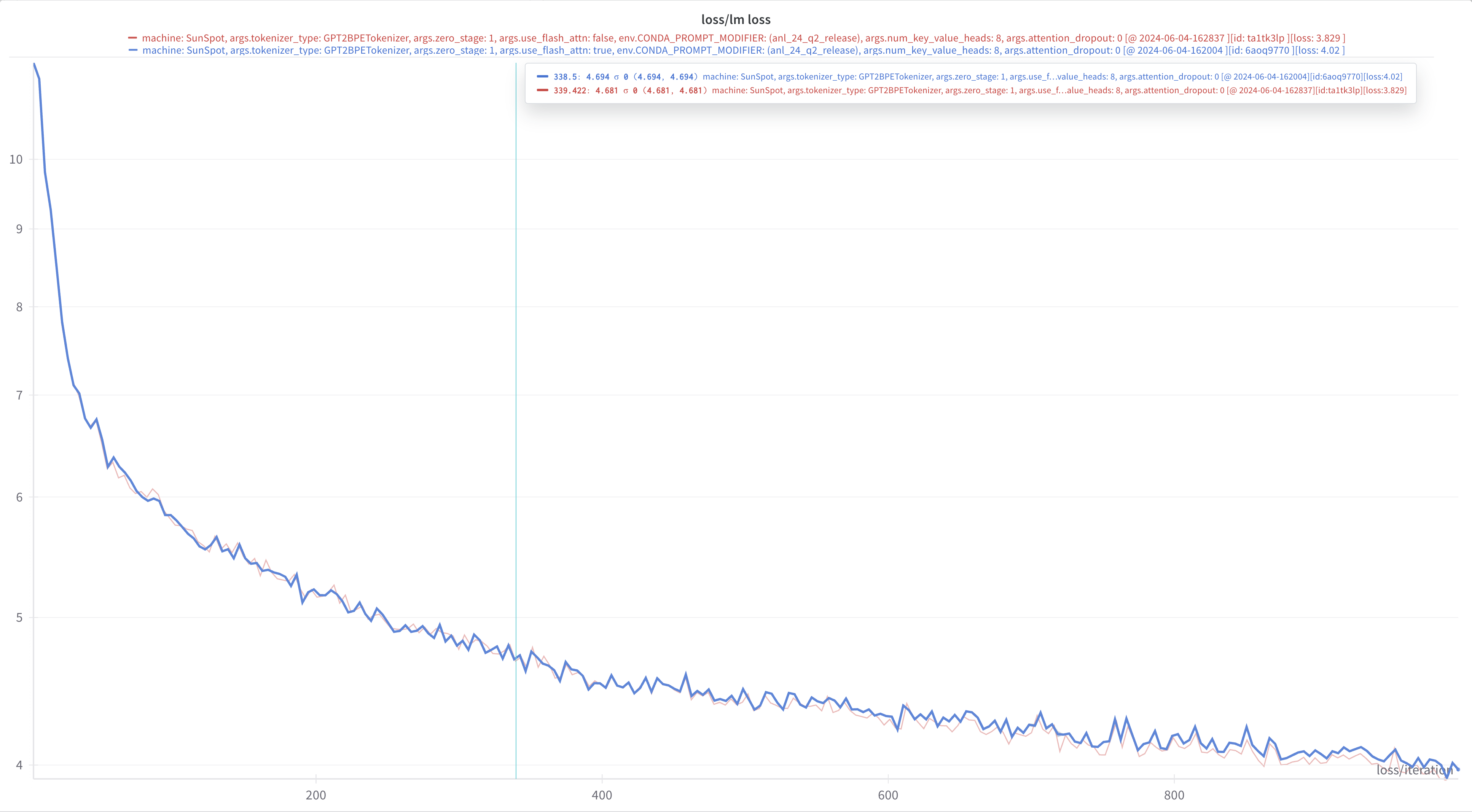
Figure 1: After correctly setting the dropout values, the loss curves were observed to agree.
🐛 Impact on Loss [Bug?]
In the q4-drop, it was observed that toggling flash-attn on / off
seemed to produce different loss curves (with otherwise identical
configs)
shared-config.yaml
TP: 1
PP: 1
GAS: 1
OPT: adamw
dtype: bf16
NLAYERS: 10
MICRO_BATCH: 2
WORLD_SIZE: 24
This can be seen clearly in the figure below:
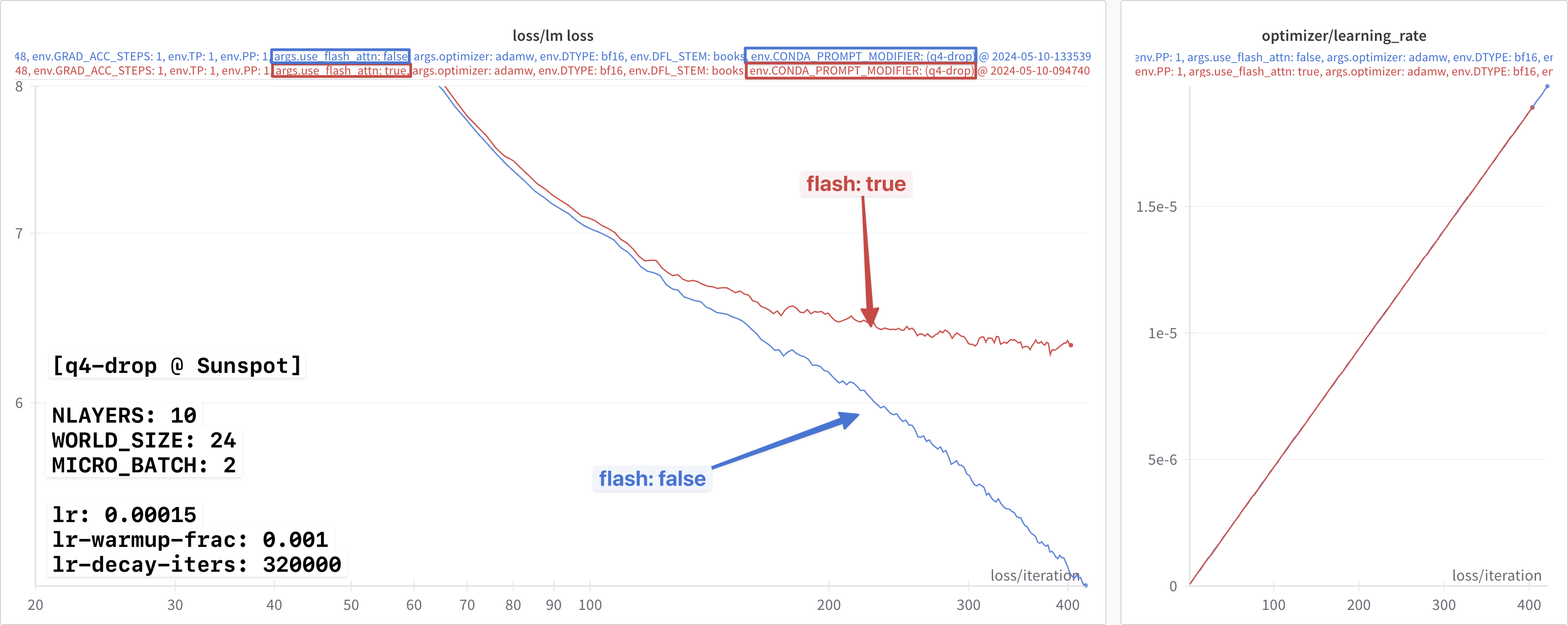
This was identified, and to be addressed in upcoming release.
📦 LLM Framework Release
On 05/14/2024, Intel dropped their new LLM frameworks release:
🎁 frameworks_2024_5_v2 Announcement:
Hi Venkat,
We have shared the official Q2 release in two different forms :
Manual Setup: /gila/Aurora_deployment/anl_24_q2_release.tar.gz
and
Module:
module use -a /home/jmitche1/anl_release/2024/q2
module load frameworks_2024_5_v2
Instructions on how to use modules with Q2 build are anl_24_q2_release/README
- The release includes :
- Megatron-DeepSpeed 0.14.2 (with patch)
- Intel® Extension for PyTorch* v2.1.30+xpu
- TorchCCL 2.1.300
- ONEAPI 2024.1.0.596.PUBLIC_IDP_2024.1.0_723
- Agama driver: 803.29
- The release provides following key features:
- Scaleup Performance improvement from the
TorchCClprototype feature enabled byTORCH_LLM_ALLREDUCE=1details - Auto TP inference support for more workloads
- Flash Attention V2 improvement for 256 head dimension support; MiCS support.
- Latest Features and Optimizations from DeepSpeed 0.14.2 and Intel® Extension for PyTorch* 2.1.30.
- Scaleup Performance improvement from the
Thanks,
Jerome
📸 flash 🤝 📷 no-flash
With this new release, Intel observed that the loss curves agreed
exactly for flash / no-flash, using the learning rate settings
below:
lr: 0.00015
lr_warmup_frac: 0.01
lr_decay_iters: 320000
Testing with Jerome’s new release:
module use -a /home/jmitche1/anl_release/2024/q2
module load frameworks_2024_5_v2
I was able to independently confirm these results, shown in 📸 flash
🤝 📷 no-flash below.
🔗 wandb links:
wandb links:- [📸
flash] W&B Run: youthful-river-1832 - [📷 no-
flash] W&B Run: earthy-wave-1830
📸 flash vs. 📷 no-flash
flash vs. 📷 no-flash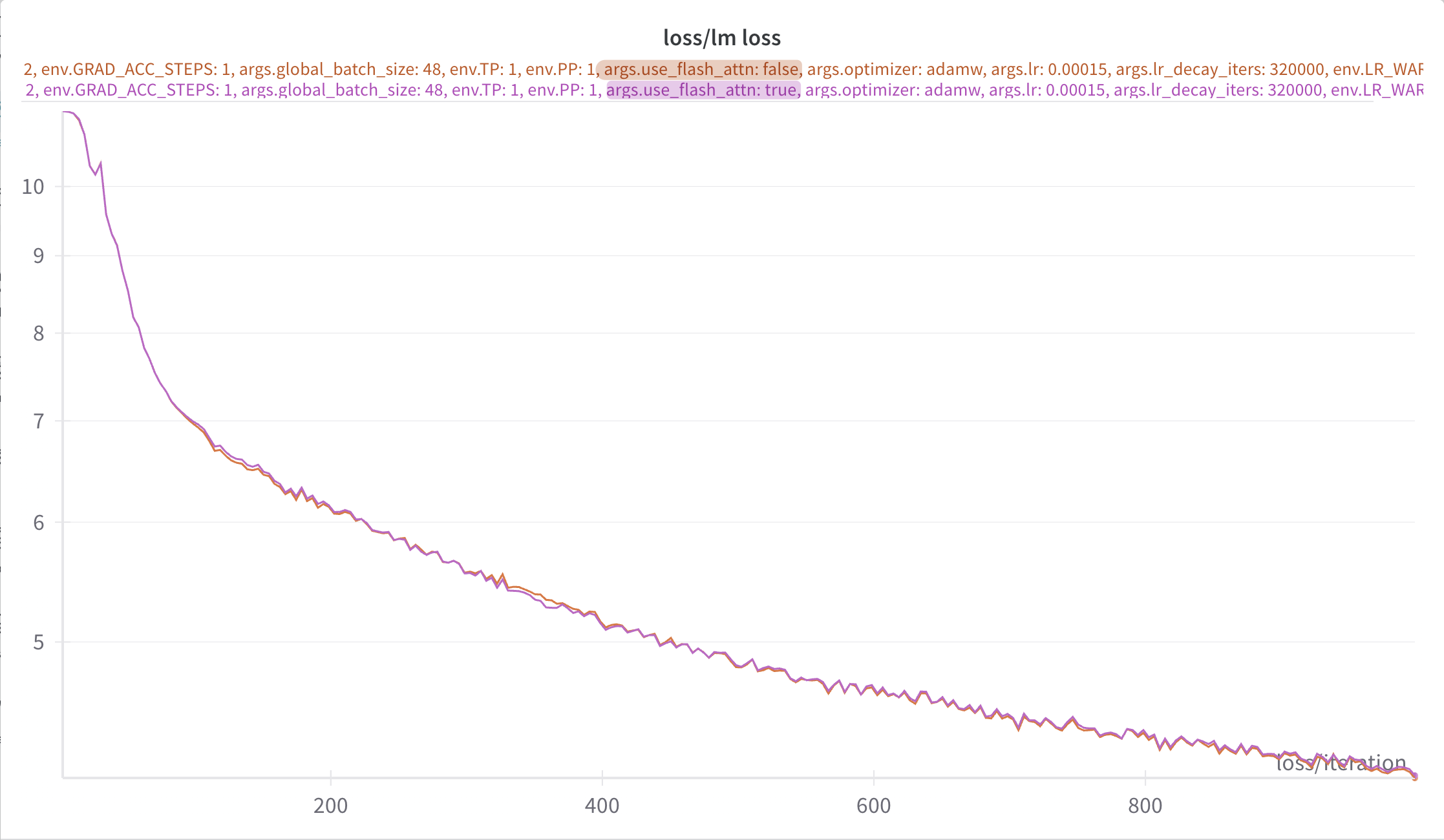
🚧 Broken MPI1
For whatever reason, things seemed to have spontaneously broken on the night of 2024-04-14 ??
When trying to run experiments the following day (05/15/2024) I was met with this2:
Abort(15): Fatal error in internal_Init_thread: Other MPI errorwhich was discussed further in this thread on slack.
It seems Subrata also encountered a similar issue [see: slack thread]
✅ mpi4py fix
mpi4py fixTo resolve this
Abort(15): Fatal error in internal_Init_thread: Other MPI errorissue we can simply load the correct modules:
module use -a /home/jmitche1/anl_release/2024/q2
module load frameworks_2024_5_v2
module use /home/ftartagl/graphics-compute-runtime/modulefiles
module load graphics-compute-runtime/agama-ci-devel-803.29
module load spack-pe-gcc/0.6.1-23.275.2 gcc/12.2.0
module use /soft/preview-modulefiles/24.086.0
module load oneapi/release/2024.04.15.001
For full details see mpi4py-reproducer, and this [slack thread].
🕵🏻 Framework Comparison
As I was re-building MPI, and after talking to Jerome, I realized that
most of the dependencies are already present in the provided
frameworks/ modules on Sunspot.
As a simple test, I tried building a new environment built on the base
conda environment3 provided by theframeworks/2023.12.15.001
module, which worked without modification and had ) most of what I
needed already installed:
>>> import torch
>>> torch.__version__
'2.1.0a0+cxx11.abi'
>>> import intel_extension_for_pytorch as ipex
>>> ipex.__version__
'2.1.10+xpu'
>>> from mpi4py import MPI
The remaining dependencies were installed according to the instructions
from the new release frameworks_2024_5_v2.
Details included below.
📦 pip Install Dependencies
pip Install DependenciesUnfortunately, the frameworks/** don’t appear to provide DeepSpeed.
We can create a virtual environment on top of the base conda by
$ module use frameworks/2023.12.15.001
$ export PBS_O_WORKDIR=$(pwd) ; source ALCF/helpers.sh && setup_venv_from_conda
Once the venv has been created and activated, we can install the
remaining dependencies:
To build / install DeepSpeed, along with its required dependencies:
-
intel-extension-for-deepspeed:python3 -m pip install intel_extension_for_pytorch_deepspeed\=\=2.1.30 -f "https://pytorch-extension.intel.com/release-whl/stable/xpu/us/intel-extension-for-pytorch-deepspeed/" -
DeepSpeed:echo "build deepspeed" git clone https://github.com/microsoft/DeepSpeed.git cd DeepSpeed git remote add yizhou_ds https://github.com/YizhouZ/DeepSpeed.git git fetch yizhou_ds git checkout yizhou/kernel_path pip install -r requirements/requirements.txt python setup.py develop |& tee build.log -
Extras:
python3 -m pip install transformers datasets python-etcd tensorboardX packaging sentencepiece bitsandbytes tiktoken neural-speed einops intel-extension-for-transformers
Looking around the available modules a bit, I noticed a newer frameworks
release (frameworks/2024.04.15.002) that had a newer version of both
torch and ipex:
module use /soft/preview-modulefiles/24.086.0
module load frameworks/2024.04.15.002.lua
python3 -c 'from mpi4py import MPI; print(MPI.__file__)'
# /soft/datascience/aurora_nre_models_frameworks-2024.1_preview_u1/lib/python3.9/site-packages/mpi4py/MPI.cpython-39-x86_64-linux-gnu.so
>>> import torch
>>> torch.__version__
'2.1.0.post2+cxx11.abi'
>>> import intel_extension_for_pytorch as ipex
>>> ipex.__version__
'2.1.30+xpu'
>>> from mpi4py import MPI; print(MPI.__file__)
/soft/datascience/aurora_nre_models_frameworks-2024.1_preview_u1/lib/python3.9/site-packages/mpi4py/MPI.cpython-39-x86_64-linux-gnu.soThe remaining dependencies were installed identically to what was just
done previously for the frameworks/2023.12.15.001 module.
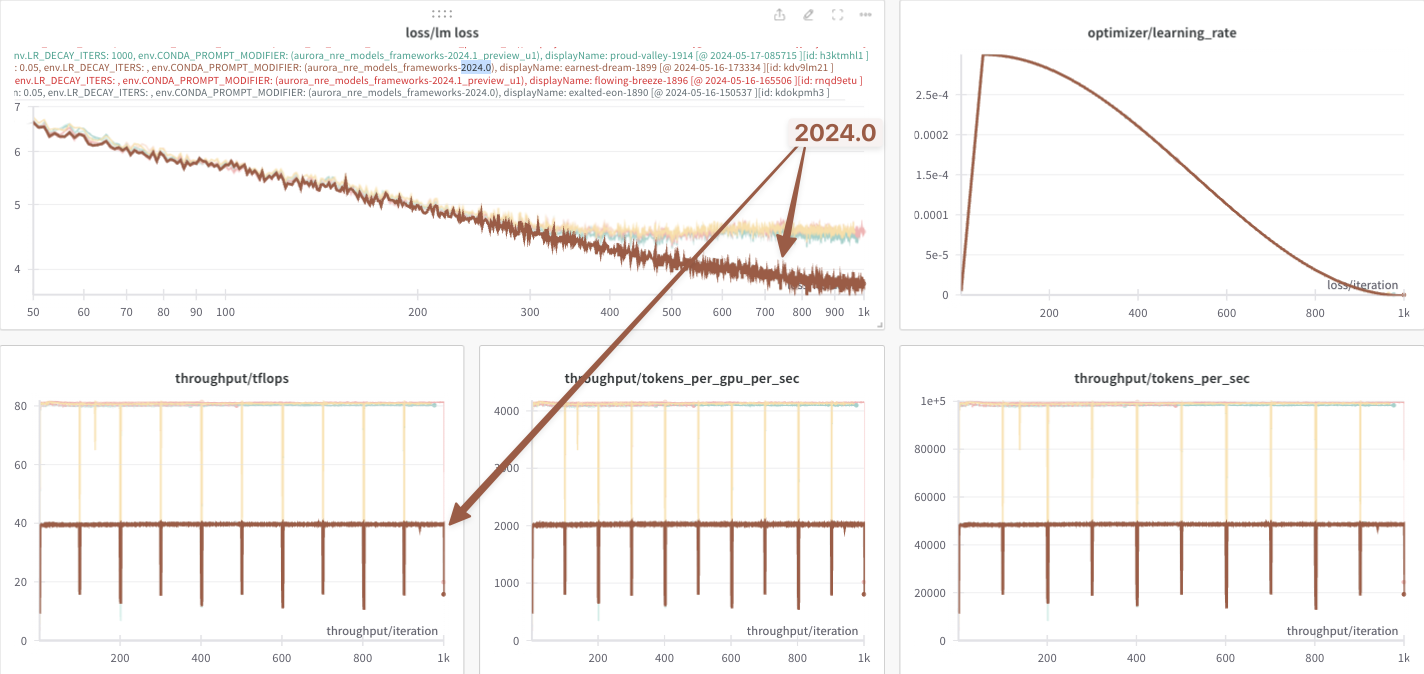
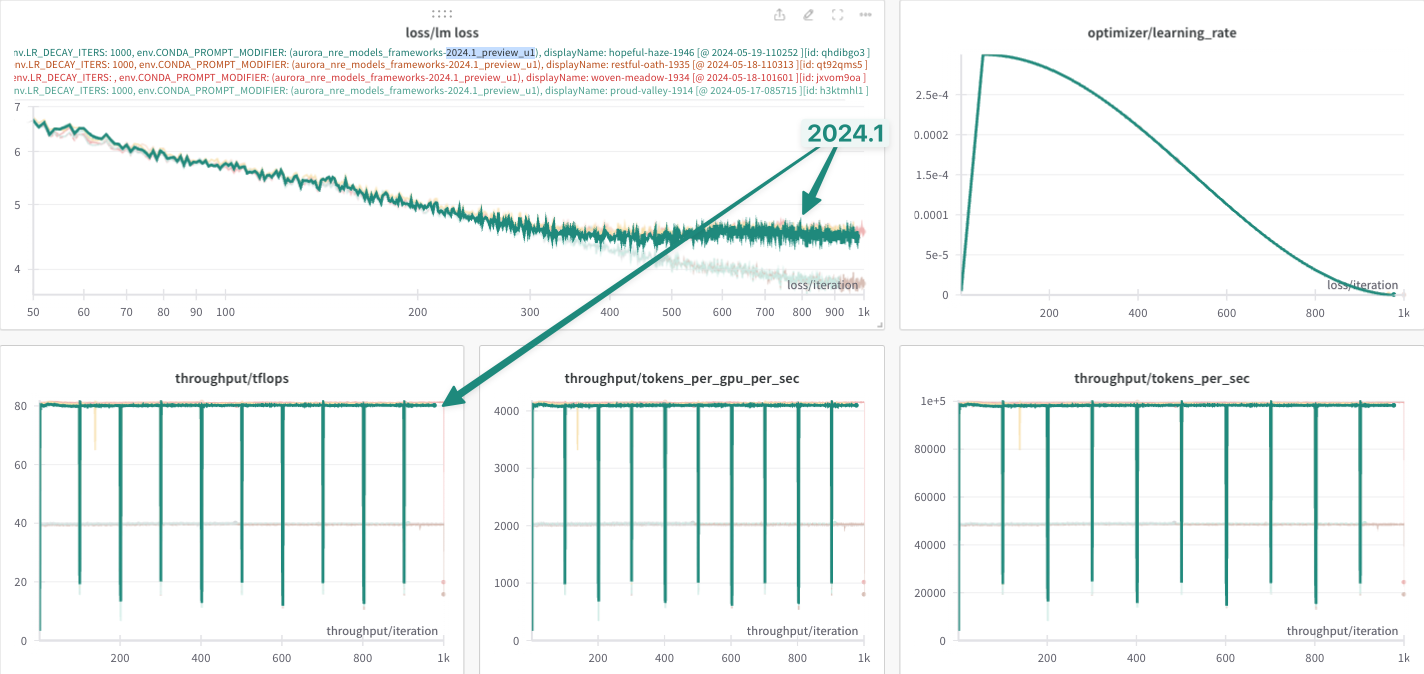
NOTE: In the figures below, we denote these two environments as:
2024.0:module load frameworks/2023.12.15.001
2024.1:module use /soft/preview-modulefiles/24.086.0module load frameworks/2024.04.15.002.lua
anl_24_q2_release:eval "$(~/miniconda3/bin/conda shell.zsh hook)"conda activate anl_24_q2_release
🥸 Fix in Disguise
Armed now with functional environment(s) for
argonne-lcf/Megatron-DeepSpeed,
I was able to resume my previous experiments.
From the discussion with Intel, it was hard to understand / reason about
why the flash-attn fix would have any dependence on the learning
rate schedule (warmup + decay).
If the flash-attn fix works for a particular learning rate schedule,
you would reasonably expect that it should work for any learning rate
schedule.
An additional source of confusion for me was that the discrepancy in the loss curves (seemingly) disappeared when using the learning rate settings provided by Intel4, but not when using the ALCF defaults5.
After thinking about it for a bit and trying to reason about possible causes, I wondered if it might not be a mix of multiple different factors:
- Small learning rate
- Very long decay
- [maybe ?] somehow dependent on the learning rate warmup fraction
- preliminary experiments seemed to suggest this was not the case
So, I was curious what would happen if I used the (larger) learning rate
value from the ALCF defaults (lr=0.003) with the very long
lr-decay-iters: 320000 from Intel.
These results are shown below.
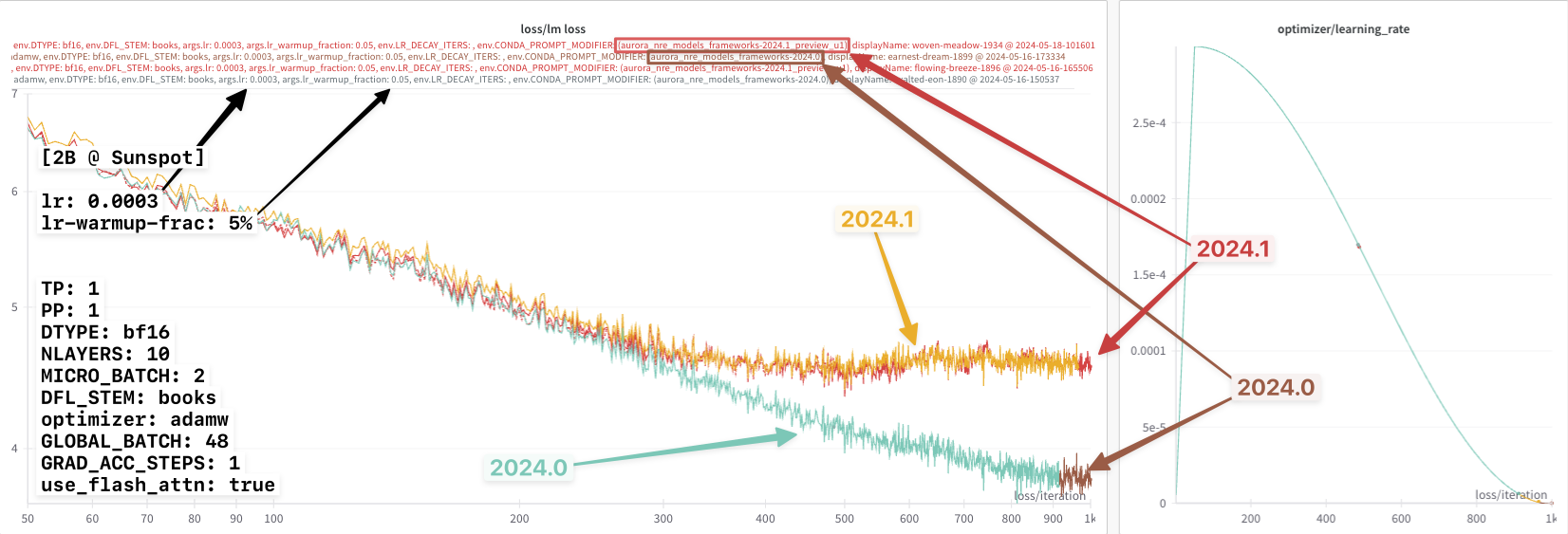
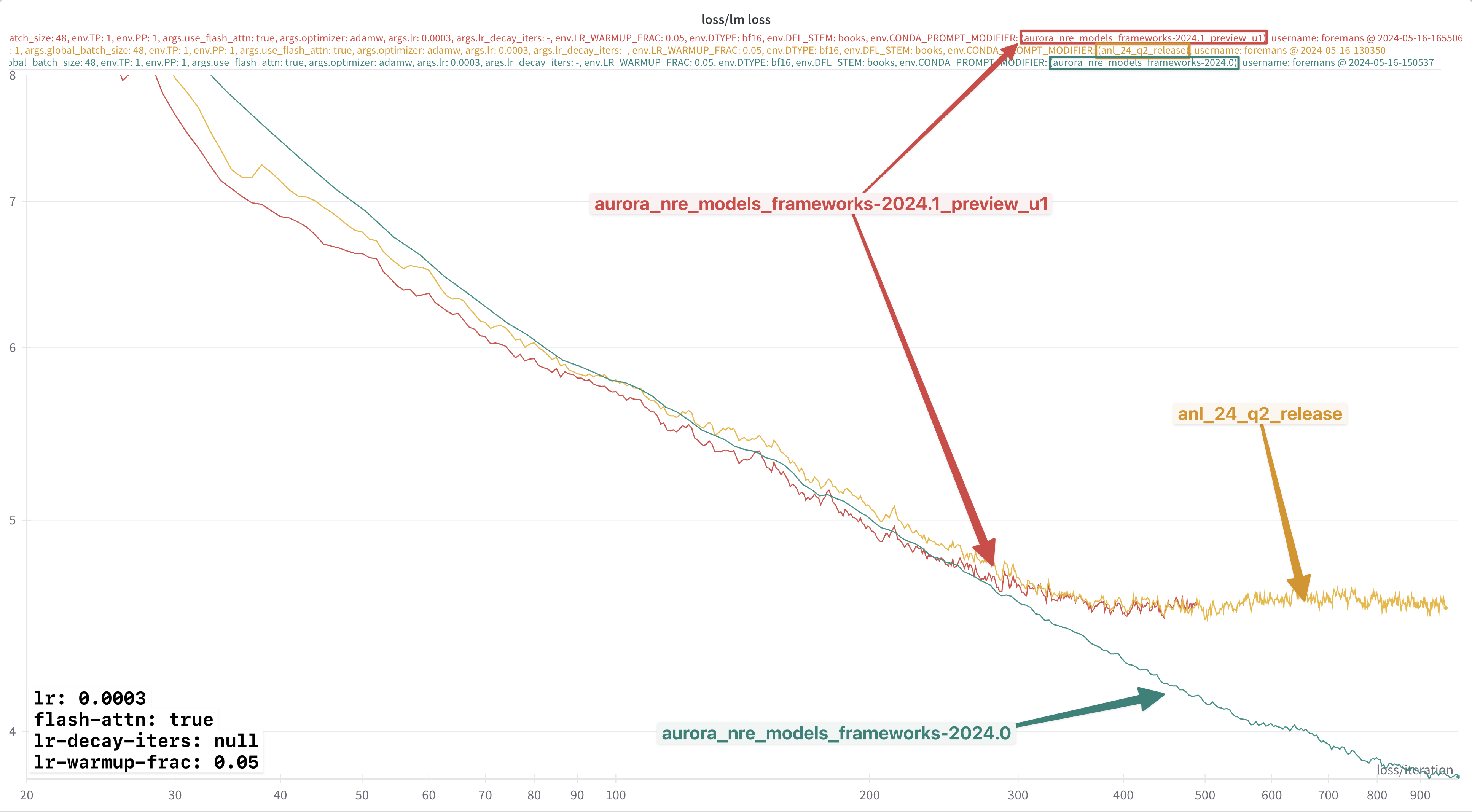
In particular, for all three experiments the following learning rate settings were used:
lr: 0.0003
lr-warmup-frac: 0.05
lr-decay-iters: 320000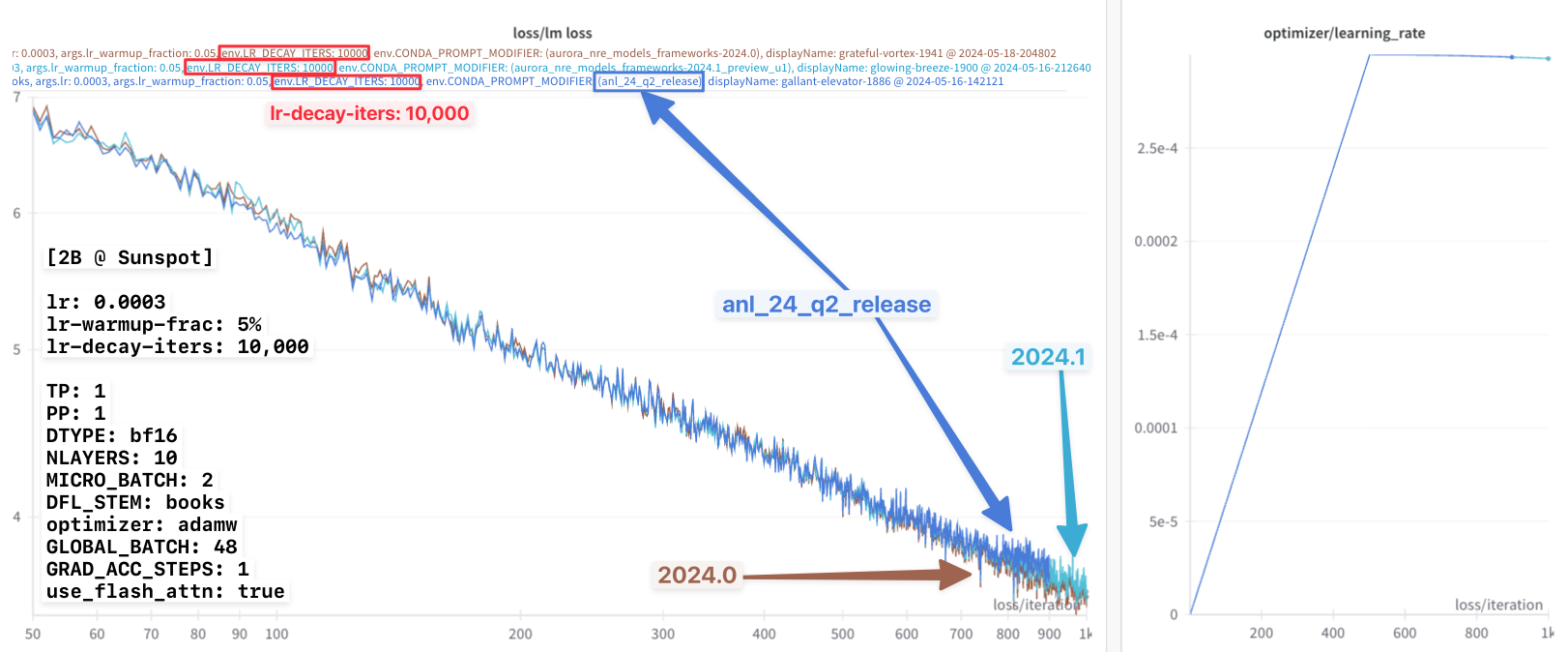
Looking at this figure ^, it appears that up until the very very end, all three loss curves agree identically.
However, if we look closely at the very end, it looks like there might
be a slight difference beginning to appear between the 2024.0 (brown
line) and {anl_24_q2_release, 2024.1} ({dark, light} blue lines,
respectively).
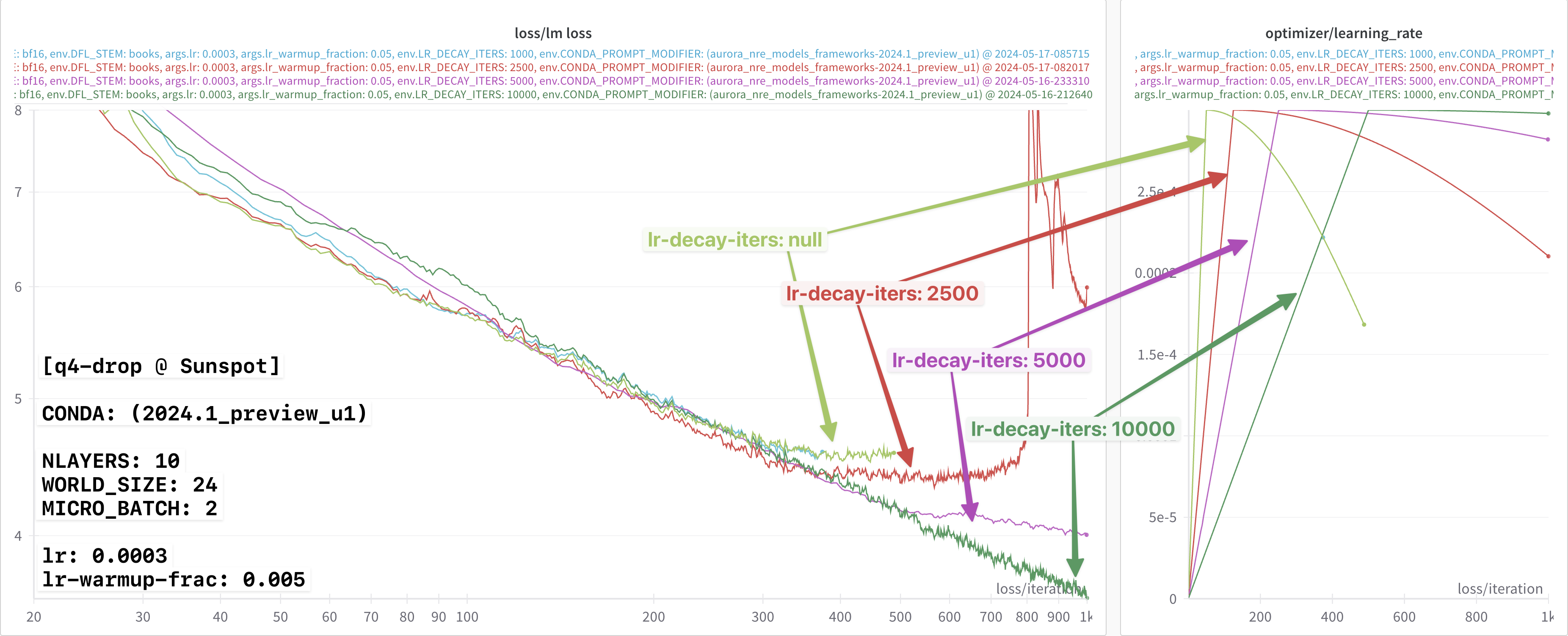
Thinking that I might be onto something, I then tried again with a
smaller lr-decay-iters: 5000.
This result is shown below:
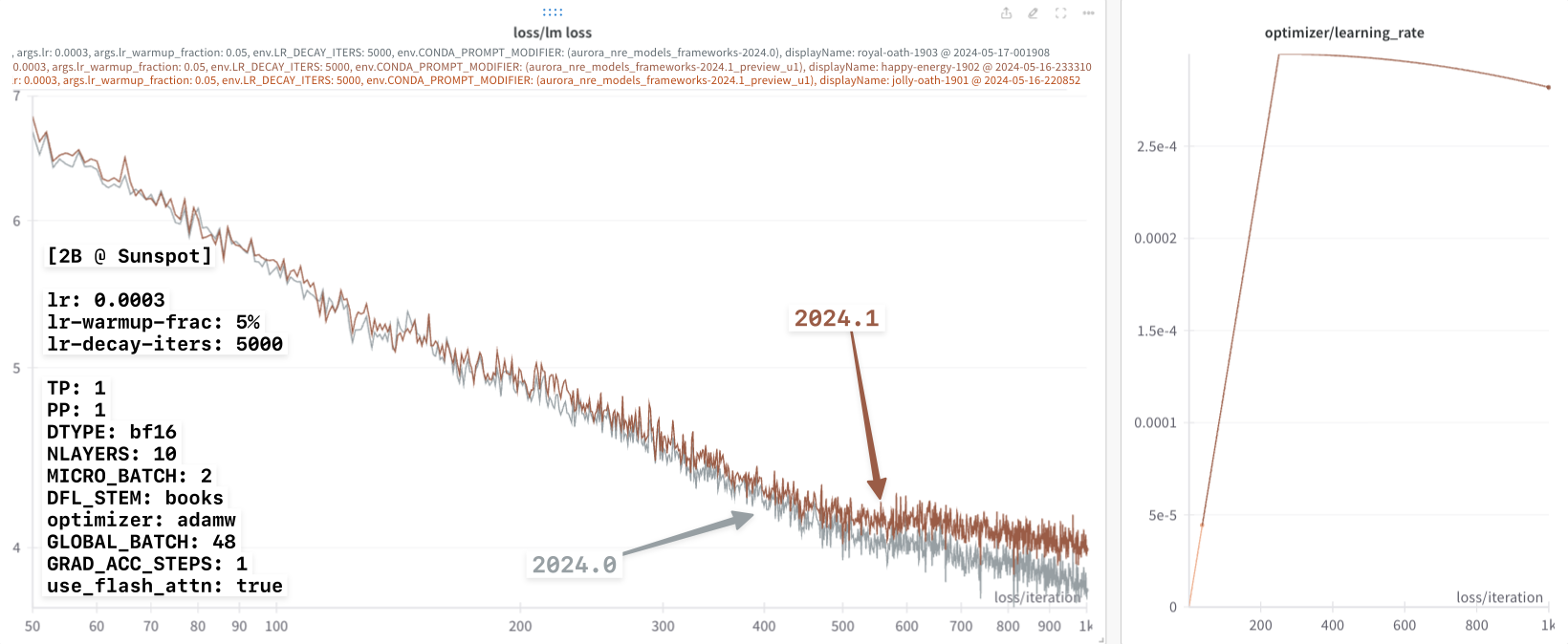
In particular, we can now more clearly see the difference beginning to
appear between the 2024.0 and 2024.1 loss curves.
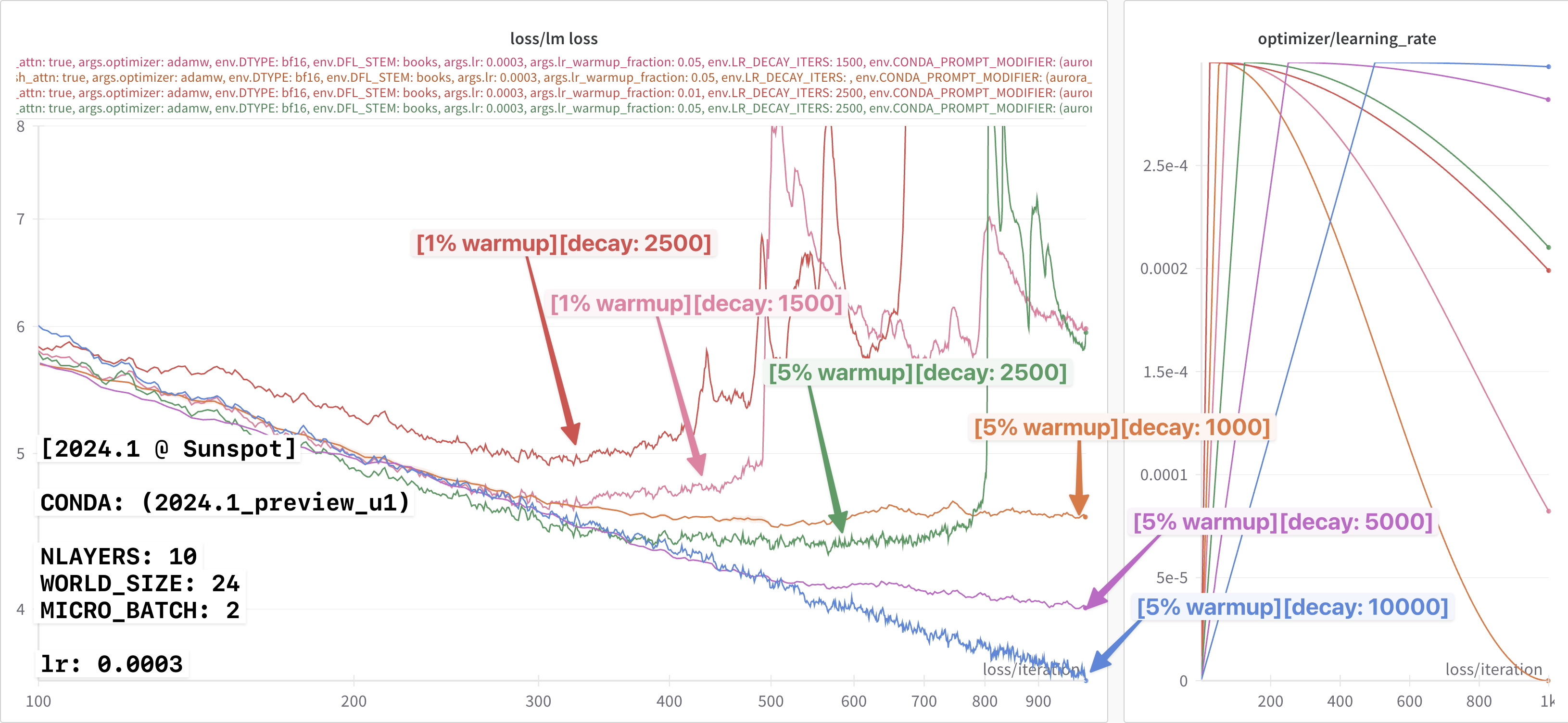
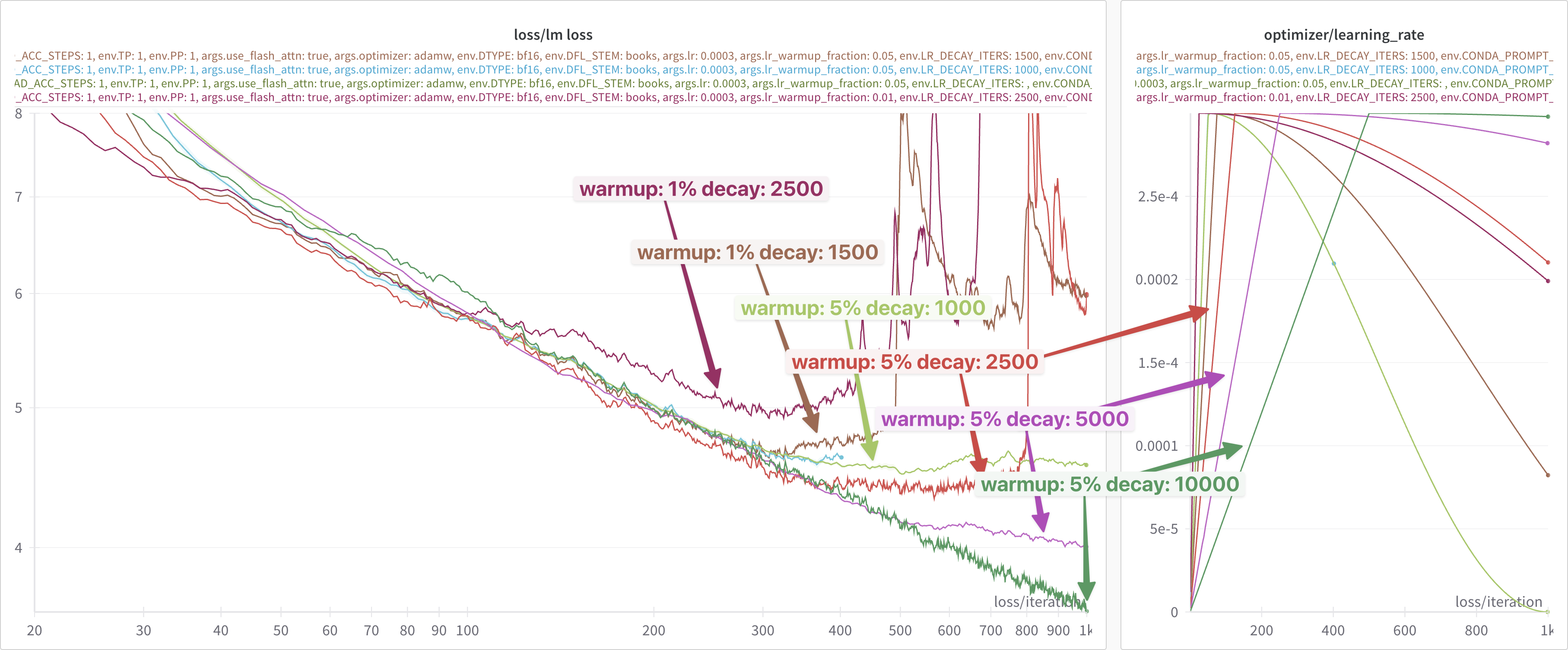
Continuing on, we see this effect become increasingly dramatic with even
smaller values of lr-decay-iters:
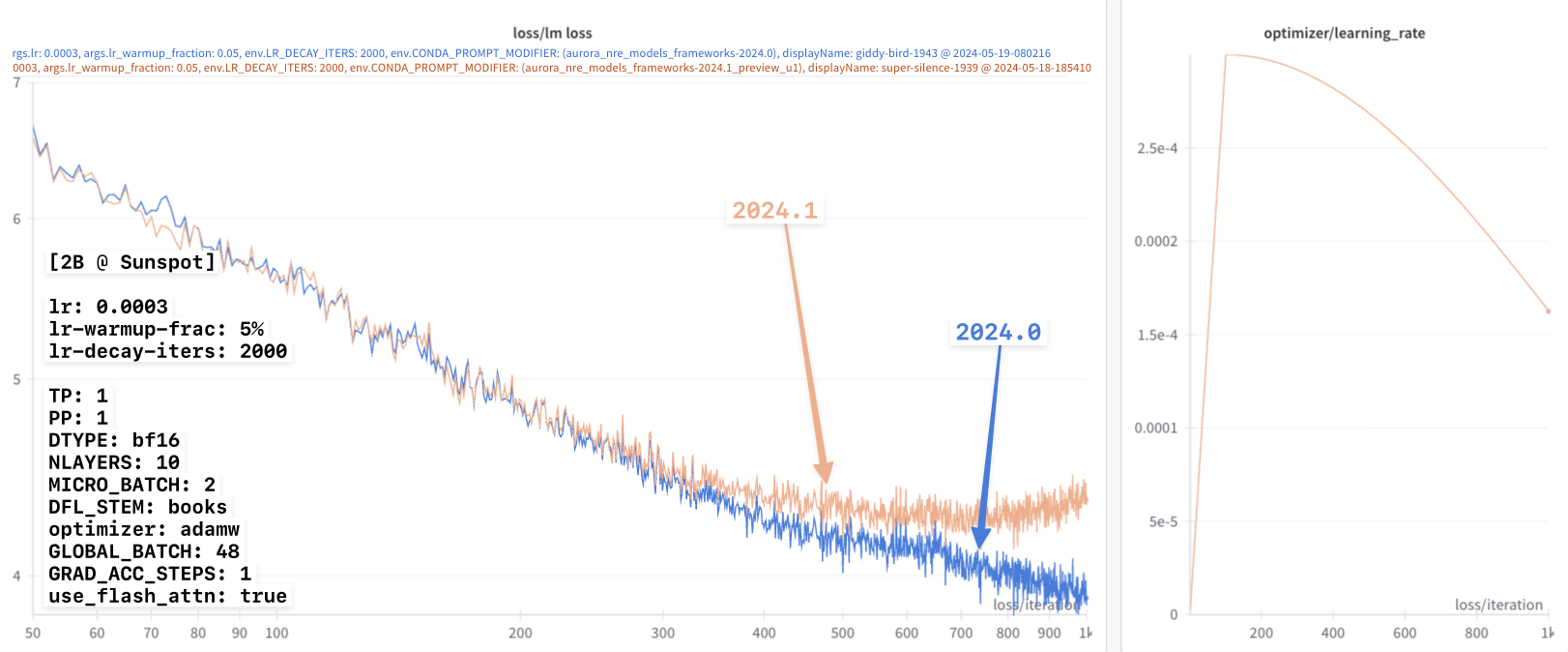
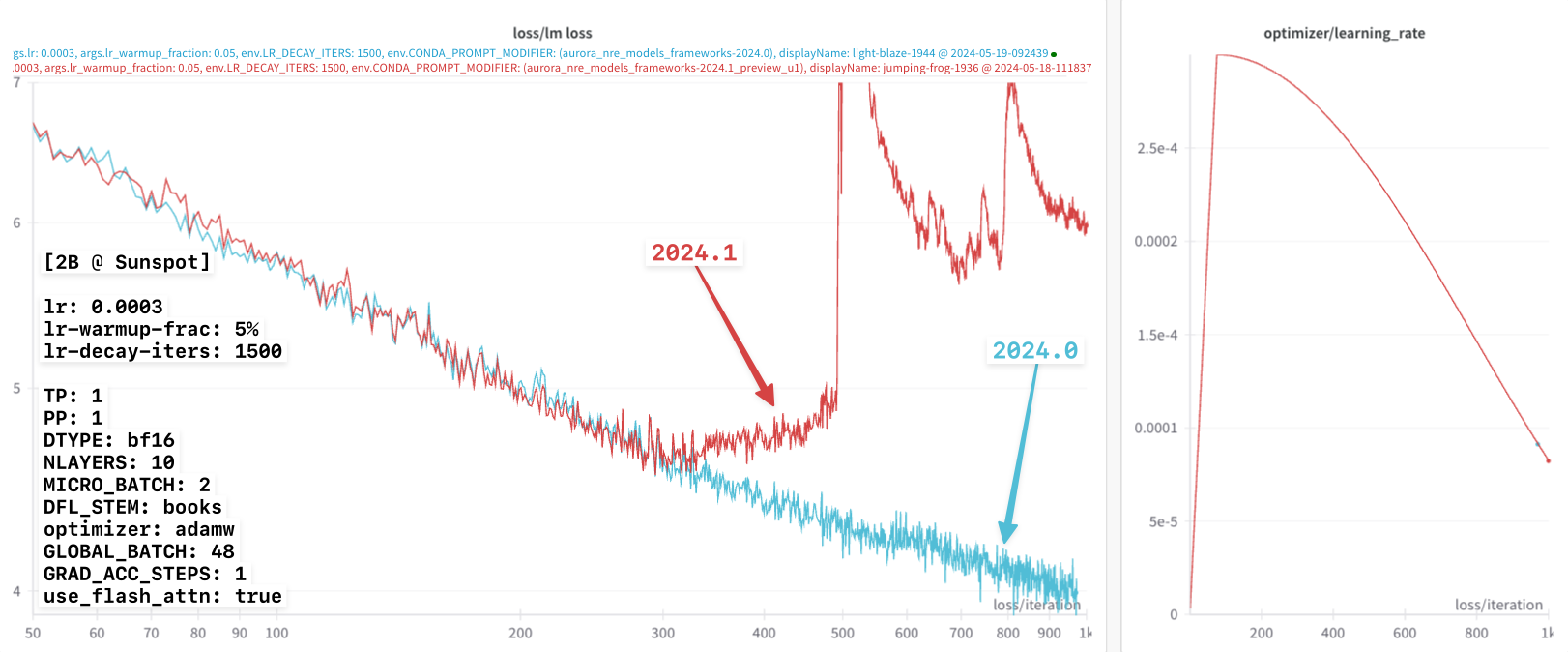
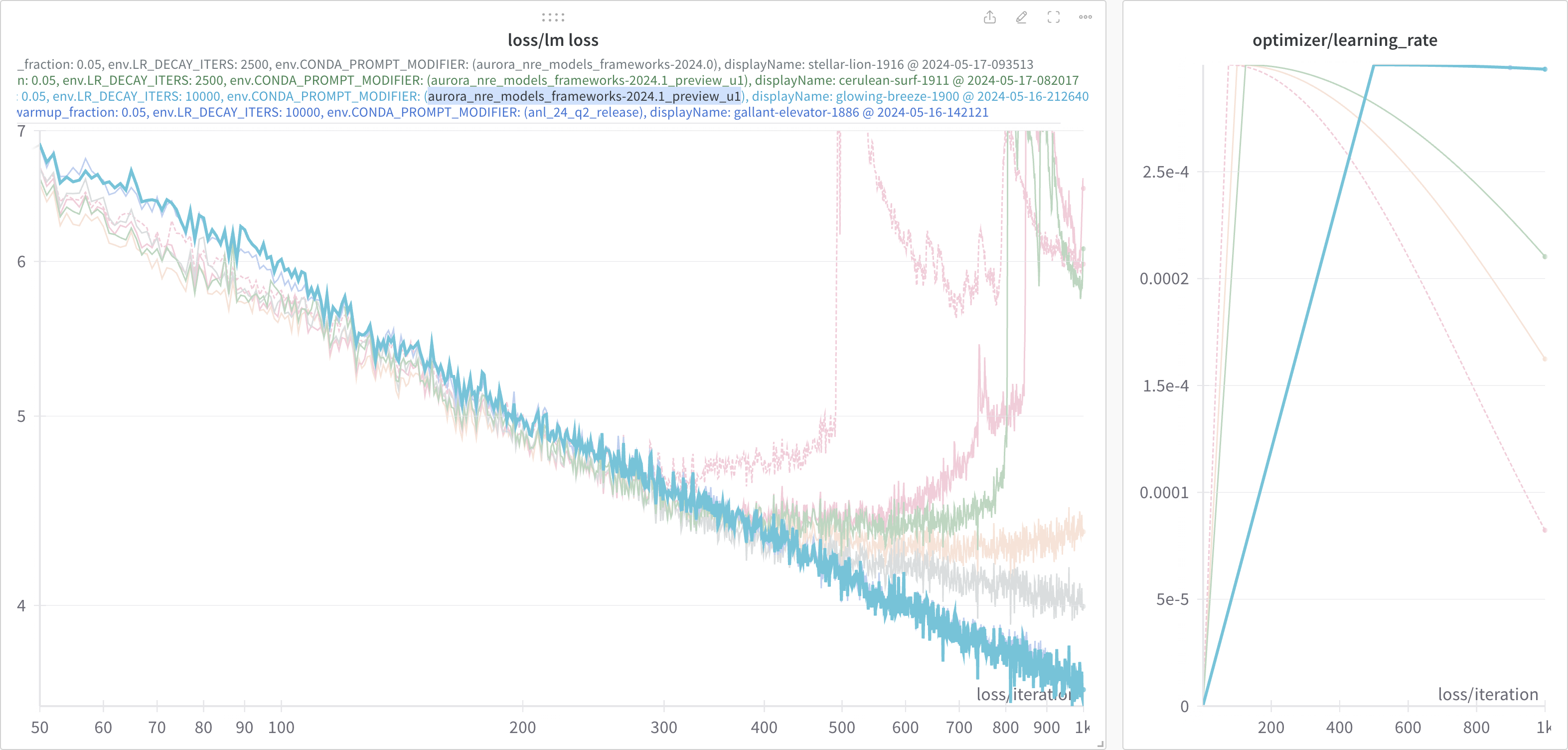
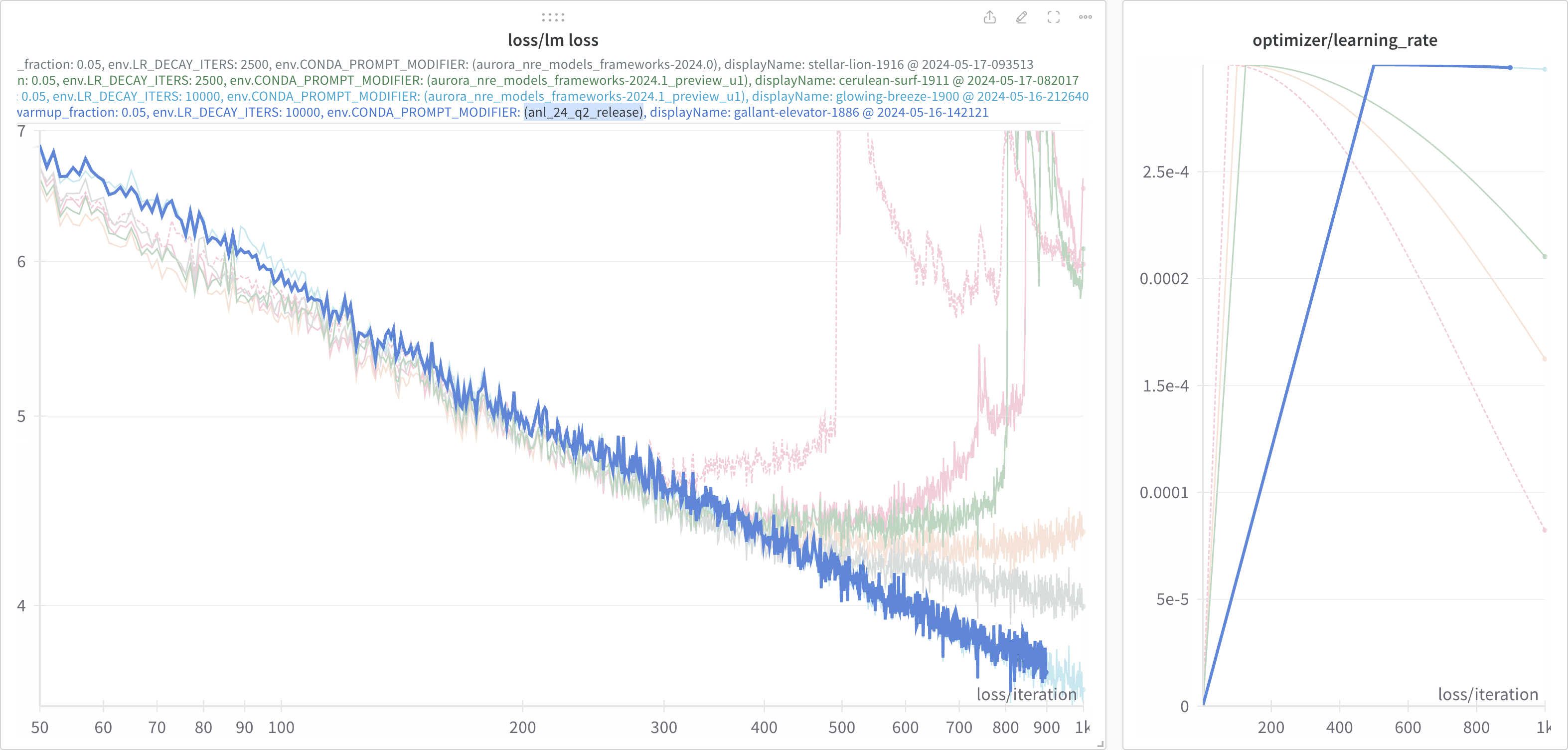
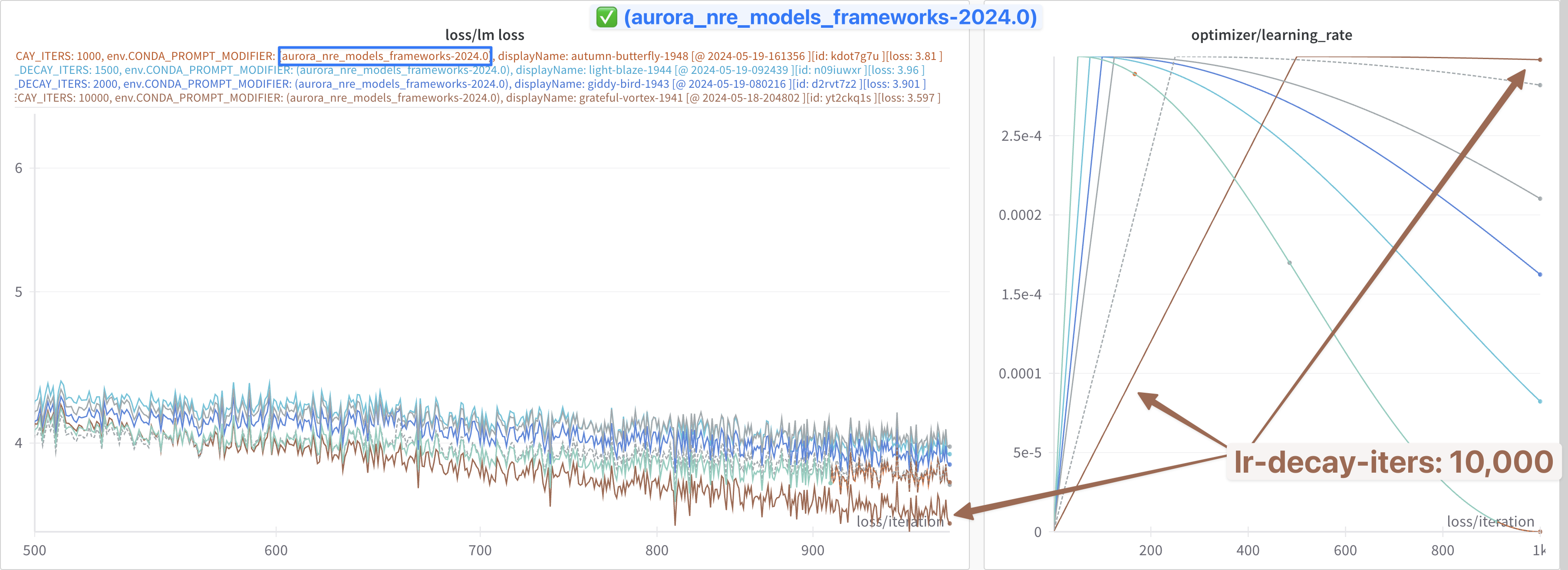
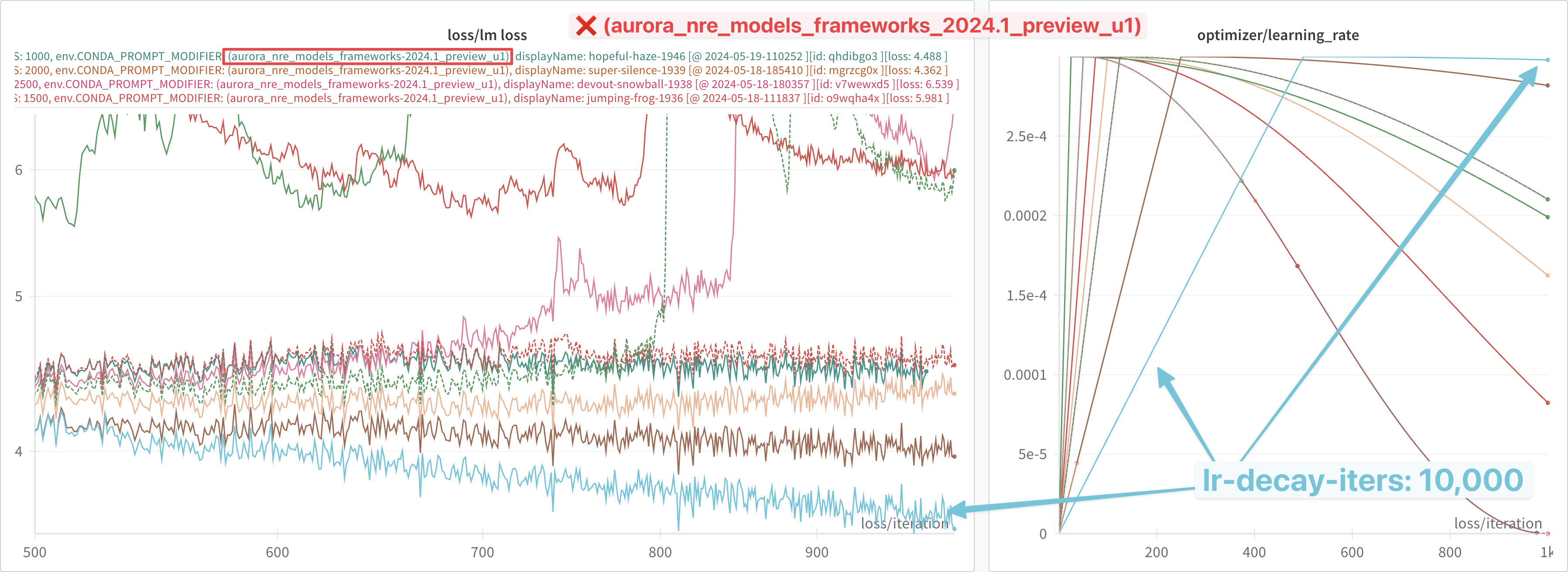
In each of these experiments, it appears that:
2024.0:- Not impacted by this
lr-decay-itersdependence - Continue to decrease for the duration of training
- Not impacted by this
2024.1:- Impacted by the
lr-decay-itersdependence - Plateaus towards the end of training
- Impacted by the
Older Figs
✅ 2024.0 Fix
Everything seems to work with
module load frameworks/2023.12.15.001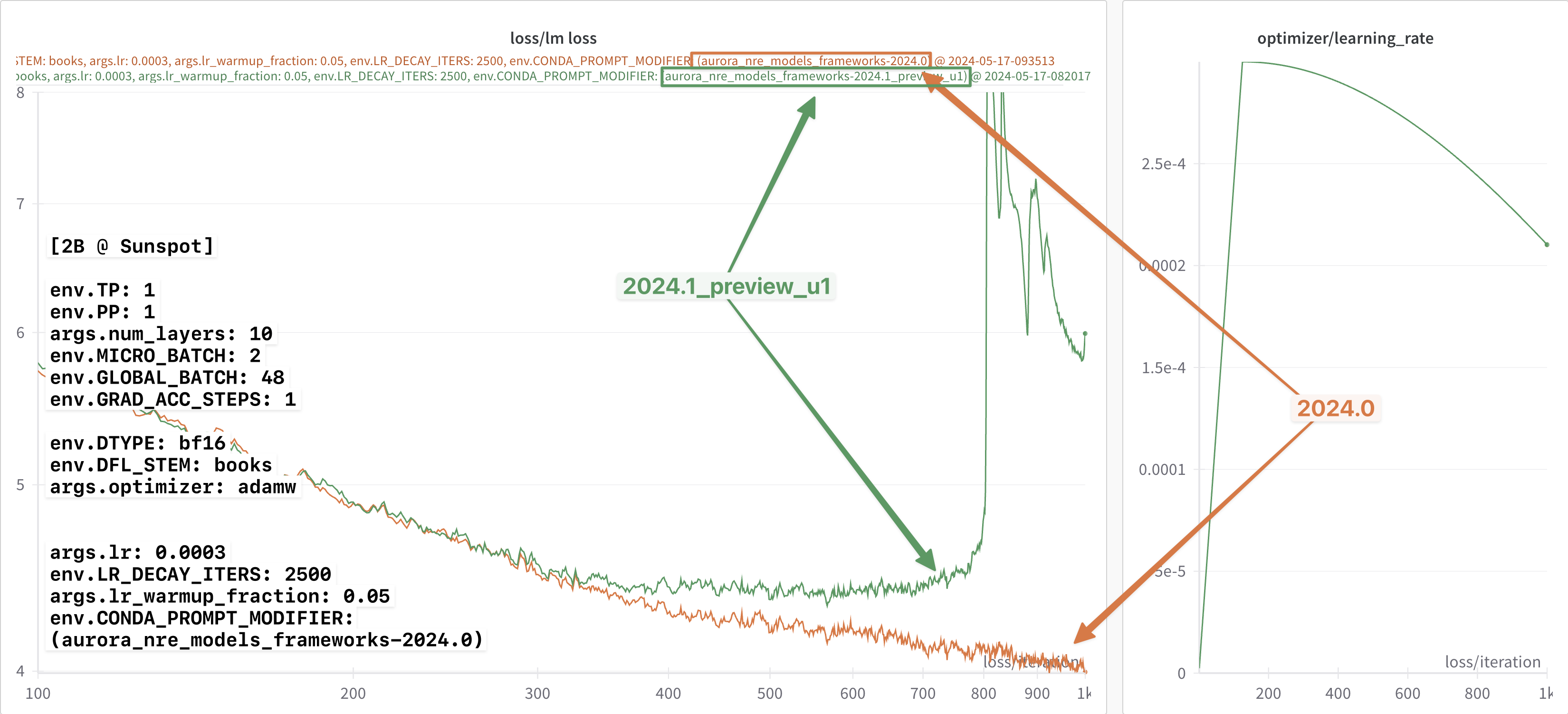
📊 lr-decay-iters Comparison
2024.0:-
2024.1:-
📈 lr-decay-iters dependence
🏎️ Performance Improvement in 2024.1
lr: 0.0003
lr-warmup-frac: 0.05
lr-decay-iters: null