AERIS: Argonne's Earth Systems Model
Sam Foreman 2025-10-08
- 🌎 AERIS
- High-Level Overview of AERIS
- Contributions
- Model Overview
- Windowed Self-Attention
- Model Architecture: Details
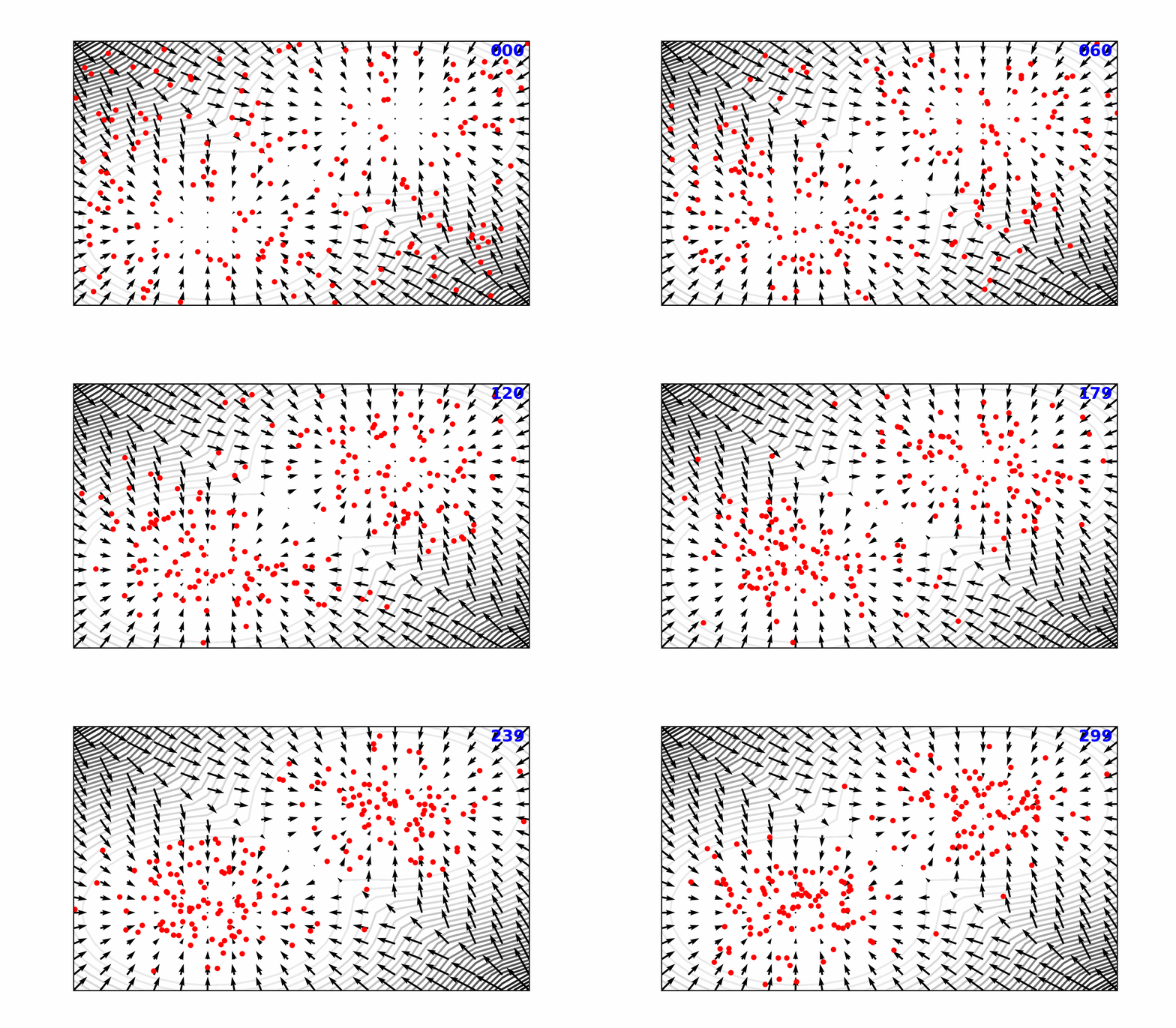
- Issues with the Deterministic Approach
- Transitioning to a Probabilistic Model
- Sequence-Window-Pipeline Parallelism
SWiPe - Aurora
- AERIS: Scaling Results
- Hurricane Laura
- S2S: Subsseasonal-to-Seasonal Forecasts
- Seasonal Forecast Stability
- Next Steps
- References
- Extras
- Acknowledgements
🌎 AERIS
Sequence-Window-Pipeline Parallelism SWiPe
SWiPeis a novel parallelism strategy for Swin-based Transformers- Hybrid 3D Parallelism strategy, combining:
- Sequence parallelism (
SP) - Window parallelism (
WP) - Pipeline parallelism (
PP)
- Sequence parallelism (
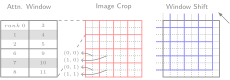
Figure 6
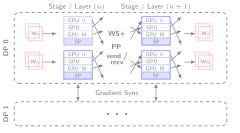
Figure 7: SWiPe Communication Patterns
Aurora
Table 3: Aurora1 Specs
| Property | Value |
|---|---|
| Racks | 166 |
| Nodes | 10,624 |
| XPUs2 | 127,488 |
| CPUs | 21,248 |
| NICs | 84,992 |
| HBM | 8 PB |
| DDR5c | 10 PB |

Figure 8: Aurora: Fact Sheet.
AERIS: Scaling Results
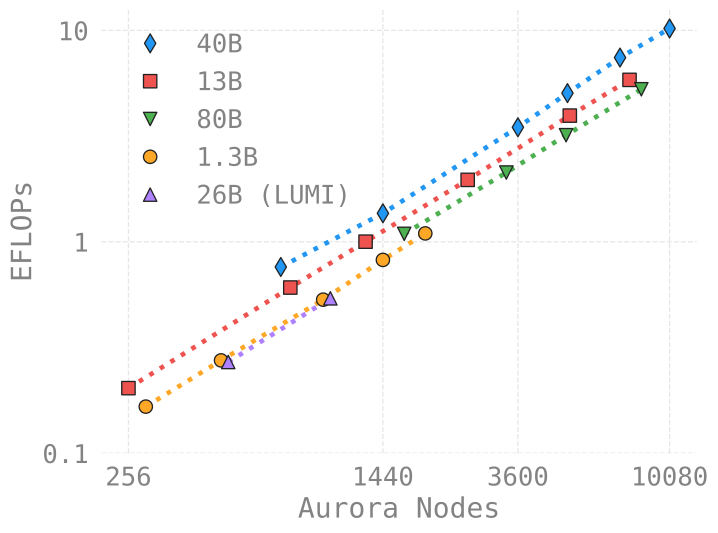
Figure 9: AERIS: Scaling Results
- 10 EFLOPs (sustained) @ 120,960 GPUs
- See (Hatanpää et al. (2025)) for additional details
- arXiv:2509.13523
Hurricane Laura
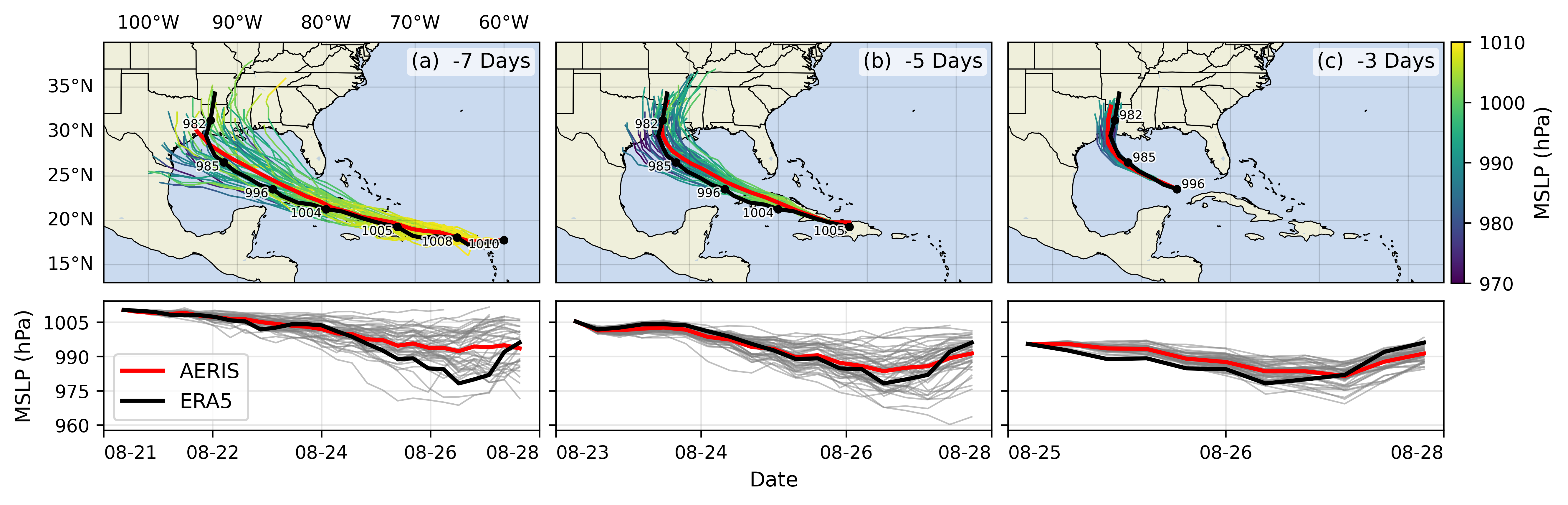
Figure 10: Hurricane Laura tracks (top) and intensity (bottom). Initialized 7(a), 5(b) and 3(c) days prior to 2020-08-28T00z.
S2S: Subsseasonal-to-Seasonal Forecasts
🌡️ S2S Forecasts
We demonstrate for the first time, the ability of a generative, high resolution (native ERA5) diffusion model to produce skillful forecasts on the S2S timescales with realistic evolutions of the Earth system (atmosphere + ocean).
- To assess trends that extend beyond that of our medium-range weather forecasts (beyond 14-days) and evaluate the stability of our model, we made 3,000 forecasts (60 initial conditions each with 50 ensembles) out to 90 days.
- AERIS was found to be stable during these 90-day forecasts
- Realistic atmospheric states
- Correct power spectra even at the smallest scales
Seasonal Forecast Stability
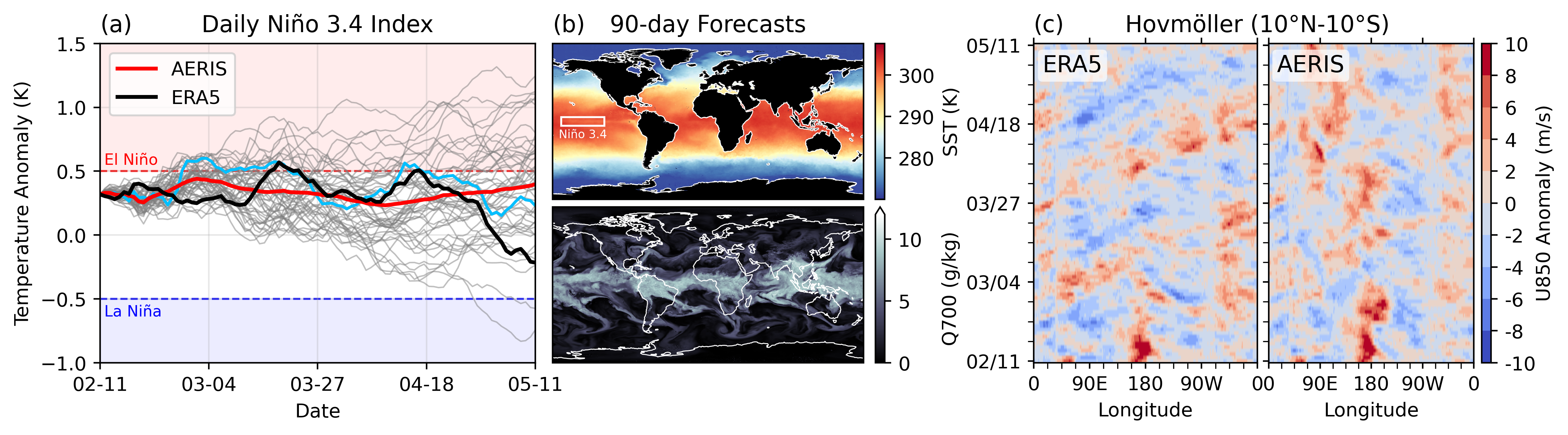
Figure 11: S2S Stability: (a) Spring barrier El Niño with realistic ensemble spread in the ocean; (b) qualitatively sharp fields of SST and Q700 predicted 90 days in the future from the
closest ensemble member to the ERA5 in (a); and (c) stable Hovmöller diagrams of U850 anomalies (climatology removed; m/s), averaged between 10°S and 10°N, for a 90-day rollout.
Next Steps
- Swift: Swift, a single-step consistency model that, for the first time, enables autoregressive finetuning of a probability flow model with a continuous ranked probability score (CRPS) objective
References
- What are Diffusion Models? | Lil’Log
- Step by Step visual introduction to Diffusion Models. - Blog by Kemal Erdem
- Understanding Diffusion Models: A Unified Perspective
Hatanpää, Väinö, Eugene Ku, Jason Stock, et al. 2025. AERIS: Argonne Earth Systems Model for Reliable and Skillful Predictions. https://arxiv.org/abs/2509.13523.
Price, Ilan, Alvaro Sanchez-Gonzalez, Ferran Alet, et al. 2024. GenCast: Diffusion-Based Ensemble Forecasting for Medium-Range Weather. https://arxiv.org/abs/2312.15796.
Extras
Overview of Diffusion Models
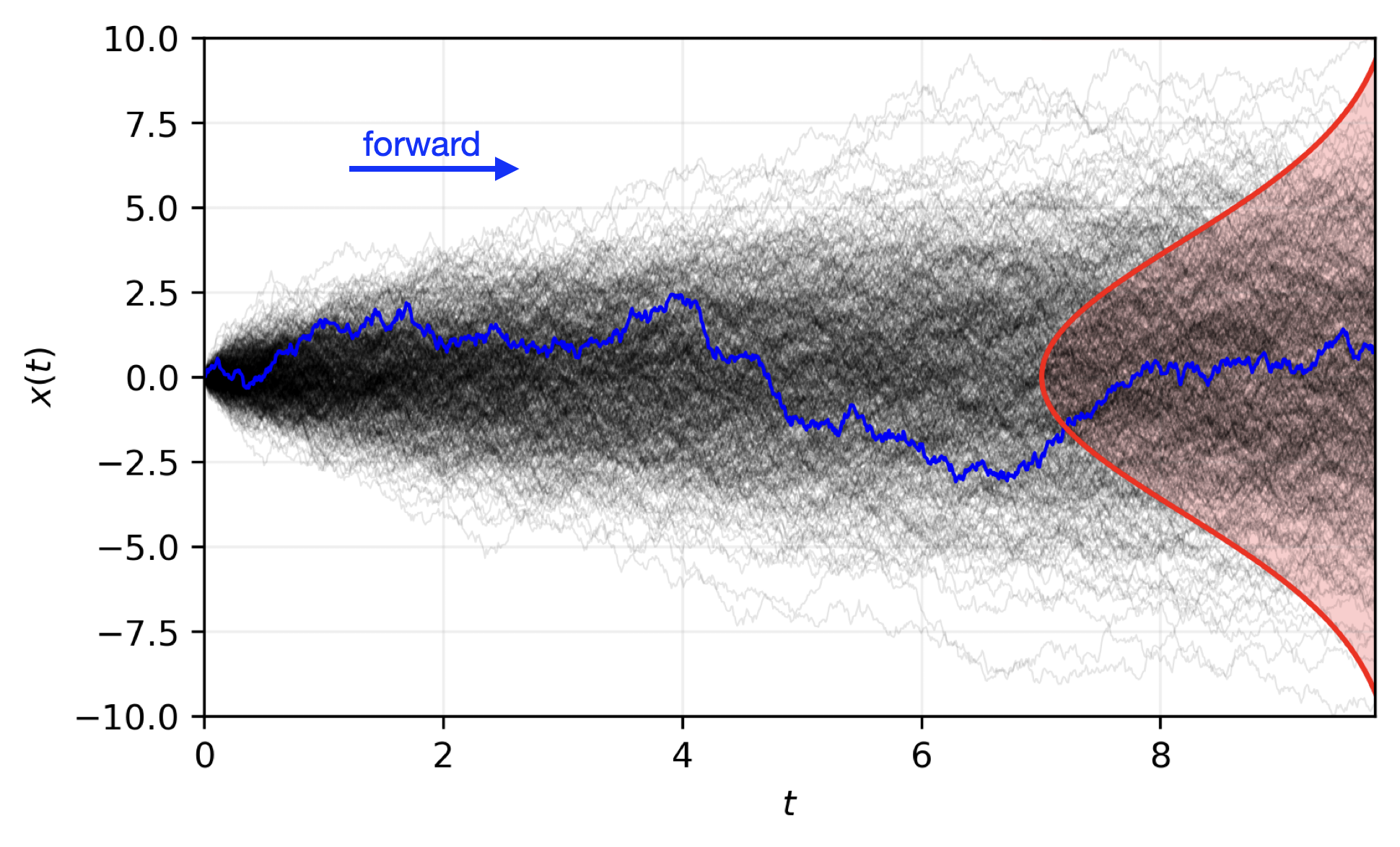
Goal: We would like to (efficiently) draw samples from a (potentially unknown) target distribution .
- Given , we can construct a forward diffusion
process by gradually adding noise to over steps:
.
-
Step sizes controlled by a variance schedule , with:
-
Diffusion Model: Forward Process
-
Introduce:
We can write the forward process as:
-
We see that the mean
Acknowledgements
This research used resources of the Argonne Leadership Computing Facility, which is a DOE Office of Science User Facility supported under Contract DE-AC02-06CH11357.
Footnotes
-
Each node has 6 Intel Data Center GPU Max 1550 (code-named “Ponte Vecchio”) tiles, with 2 XPUs per tile. ↩