LLMs on Aurora: Overview
Sam Foreman 2025-05-21
- ALCF Incite Hackathon 2025
- 🎯 AuroraGPT: Goals
- 🦙 Issues with “Publicly Available” LLMs
- 🧪 AuroraGPT: Open Science Foundation Model
- 📊 AuroraGPT: Outcomes
- 📚 What do we hope to get?
- 🌌 Aurora
- 🤖 ALCF AI Testbed
- 👥 Team Leads
- 🤝 Teams
- 📚 Data
- ⏱️ Dataset Processing
- 🚀 Accelerating Dataset Processing: Results
- 🦜 Model Training
- 📉 Loss Curve: Training AuroraGPT-7B on 2T Tokens
- 🤔 Evaluating FM Skills for Science
- ⚖️ Evaluating FM Skills for Science: Criteria
- 🧬 MProt-DPO: Scaling Results
- 📓 References
- ❤️ Thank you!
- 📑 Bibliography
- 🧬 MProt-DPO: Scaling Results
- 🚂 Loooooooooong Sequence Lengths
- ♻️ Life Cycle of the LLM
- 🍎 Training LLMs
ALCF Incite Hackathon 2025
- 2025 ALCF INCITE GPU Hackathon (20-May 22, 2025)
- LLMs on Aurora1:
🎯 AuroraGPT: Goals
AuroraGPT: General purpose scientific
LLM
Broadly trained on a general corpora plus scientific papers, texts, data
- Explore pathways towards a “Scientific Assistant” model
- Build with international partners (RIKEN, BSC, others)
- Multilingual English, 日本語, French, German, Spanish
- Multimodal: images, tables, equations, proofs, time series, graphs, fields, sequences, etc

Figure 1: Image from Hannibal046 /
Awesome-LLM

Figure 2: Credit to the entire AuroraGPT team for slides.
- Here to talk about AuroraGPT, Argonne’s internal effort to build a general purpose scientific LLM, broadly trained on a general corpora of text + scientific {papers, text, data}
- As part of this effort, we plan to…
- Explore pathways, build with international partners, multi-{lingual, modal}
- Rough timeline of the project and deliverables:
- 202{3,4}: text-only models, plan to release a series of {7B, 70B, 1T} models
- 202{4,5}: Basic multi-modal models
- 202{5,6}: Advanced scientific multimodal models
🦙 Issues with “Publicly Available” LLMs
- Trust and Safety:
- Skepticism about deployment in critical infrastructure
- Correctness and reliability of model outputs
- Transparency:
- Data governance, what was used for pre-training? fine-tuning?
- generally unknown
- What is open source?
- Model weights?
- Pre-training {code, logs, metrics} ?
- Data governance, what was used for pre-training? fine-tuning?
- Why are we doing this?
- What is the issue with current LLMs?
- Trust and safety
- Hallucinations, false confidence
- Can this be reliably mitigated?
- Scaling up inference compute seems to help
- reasoning models, TTT, etc.
- Transparency
- Different frontier labs have different definitions of “open source”
- e.g. Llama no longer releases base models
- Libgen ??
- AllenAI institute, olmo models good example
- Trust and safety
🧪 AuroraGPT: Open Science Foundation Model

Figure 3: High-level overview of AuroraGPT project
- AuroraGPT will be a publicly distributed, open source foundation model for open science
- Is being trained on:
- Scientific / engineering structured data
- General text, media, news, etc.
- Large amounts of low to medium quality data
- Much less high quality data (that is publicly available for use)
- This data is then cleaned, processed, de-duplicated and used for the initial pre-training phase of the model
- The vast majority of the overall compute is spent during this initial
pre-training phase
- This is the group I help to lead and will be talking a bit about today
- The initial pre-training phase is currently underway
- Eventually, given a bit of time, effort and magic, the model will be ready for fine-tuning and additional training for a variety of downstream tasks
- The pretrained model will then be handed off for additional
fine-tuning on a variety of downstream tasks
- Scientific discovery
- Accelerate scientific tasks
- Digital twins
- Inverse design
- Code optimization
- Accelerated simulations
- Autonomous experiments
- Co-design
- Becoming increasingly clear that LLMs have the potential to
drastically accelerate computational science
- We’ve seen this already for {GenSLMs, Weather / Climate / Earth Systems Modeling, Particle Physics, etc.}
📊 AuroraGPT: Outcomes
-
Datasets and data pipelines for preparing science training data
-
Software infrastructure and workflows to train, evaluate and deploy LLMs at scale for scientific resarch purposes
- argonne-lcf/Megatron-DeepSpeed
End-to-end training and inference, on any GPU cluster
- argonne-lcf/inference-endpoints
Inference endpoints for LLMs, hosted @ ALCF
- argonne-lcf/Megatron-DeepSpeed
-
Evaluation of state-of-the-art LLM Models:
- Determine where they fall short in deep scientific tasks
- Where deep data may have an impact
📚 What do we hope to get?
- Assessment of the approach of augmenting web training data with
two forms of data specific to science:
- Full text scientific papers
- Structured scientific datasets (suitably mapped to narrative form)
- Research grade artifacts (models) for scientific community for adaptation for downstream uses2
- Promotion of responsible AI best practices where we can figure them out
- International Collaborations around the long term goal of AGI for science
- Deliverables:
- datasets, pipelines
- software infrastructure, workflows to interface with science applications
- checkpoints, models, logs, workbook, insights, etc.
- Hope to understand:
- How different state-of-the-art models perform at different scientific tasks
- where deep data may have an impact
- feasibility of generically augmenting text with scientific structured data
- Huge undertaking that will require large international collaborations around long term goal of AGI for science
- Extra points:
- Well known that LLMs are good for non-consequential tasks
- Known to “hallucinate” and create false information
- Can this be mitigated reliably ??
🌌 Aurora
Table 1: Aurora Specs
| Racks | 166 |
| Nodes | 10,624 |
| CPUs | 21,248 |
| GPUs | 63,744 |
| NICs | 84,992 |
| HBM | 8 PB |
| DDR5c | 10 PB |
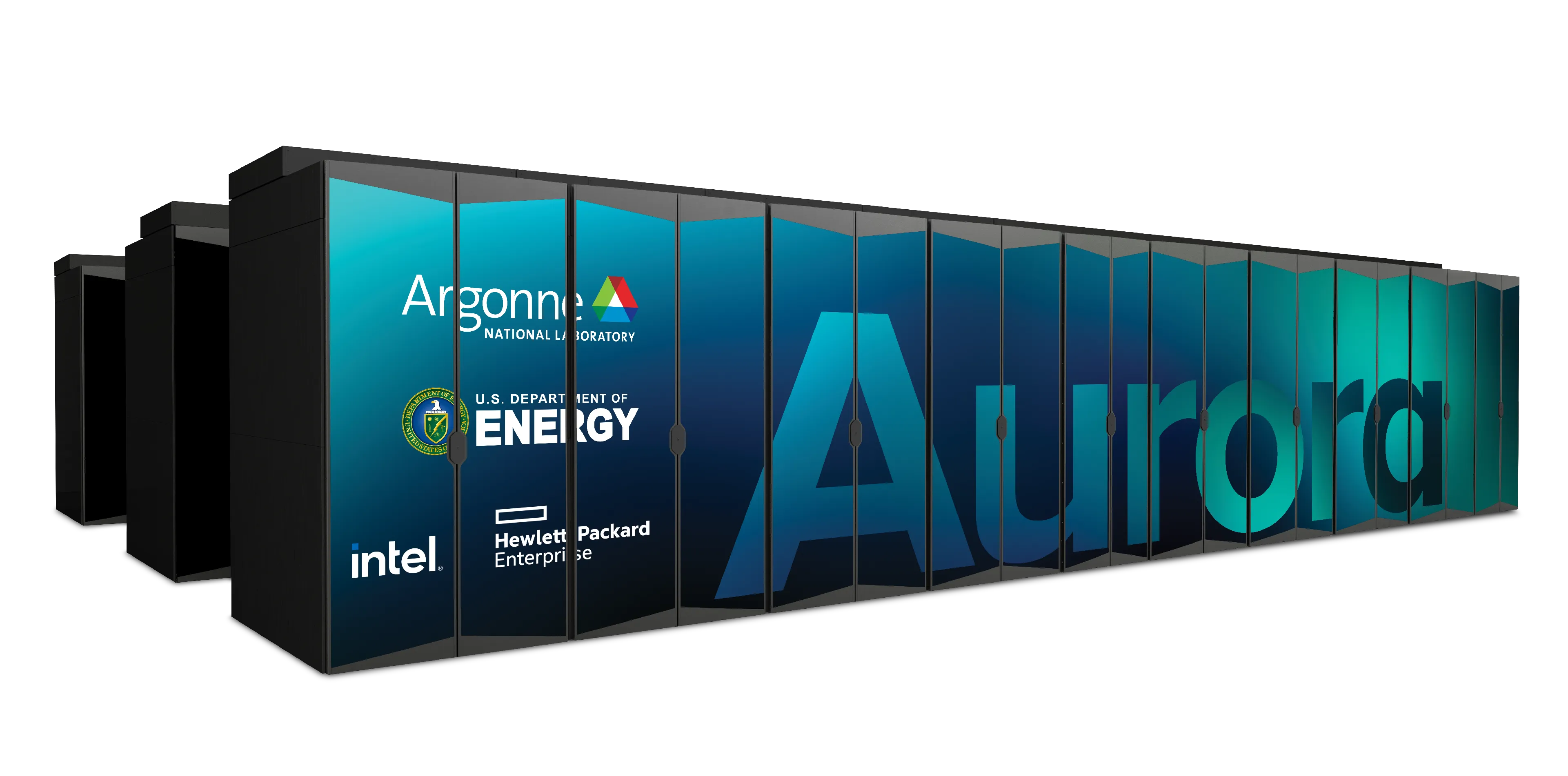
Figure 4: Aurora: Fact Sheet.
🤖 ALCF AI Testbed
- ALCF AI Testbed Systems are in production and available for allocations to the research community
- Significant improvement in time-to-solution and energy-efficiency for diverse AI for science applications.
- NAIRR Pilot
Up to 25 throughput improvement for genomic FMs with 6.5 energy efficiency
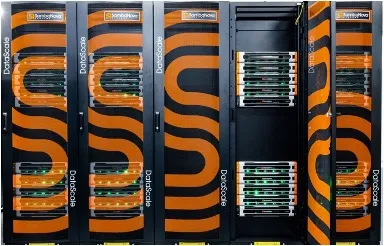
Figure 5: SambaNova SN-30 2nd Gen, 8 nodes with 64 AI Accelerators
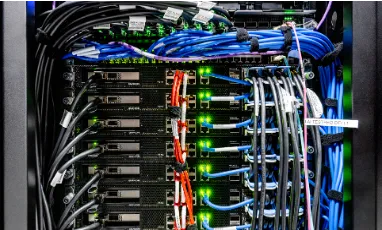
Figure 6: Graphcore Bow: Pod-64 configuration with 64 accelerators
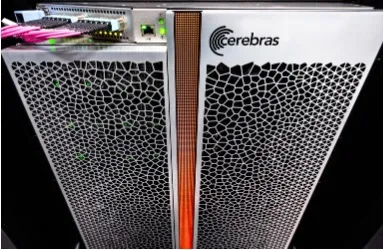
Figure 7: Cerebras: 2x CS-2 WSE with Memory-X and Swarm-X technologies
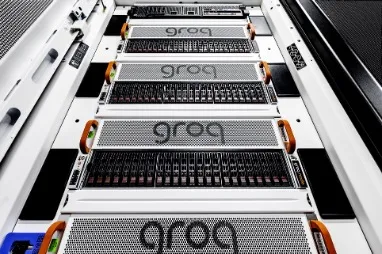
Figure 8: GroqRack: 9 nodes, 8 GroqChip v1.5 Tensor streaming processors accelerators per node
👥 Team Leads
Planning


Data

Training


Evaluation


Post


Inference

Comms


Distribution

🤝 Teams
- Planning
- Data Prep
- Accumulate 20+ T tokens of high-quality scientific text and structured data
-
Models / Training
3 - Train (entirely from scratch) a series of models on publicly available data - Evaluation
- Skills, trustworthiness, safety, robustness, privacy, machine ethics
- Post-Training
- Fine-tuning, alignment
- Inference
- Model serving, API development / public-facing web services
- Distribution
- Licensing, generating and distributing artifacts for public consumption
- Communication
📚 Data
✅ Goal: Assemble a large corpus of documents (general and scientific) to train and fine-tune AuroraGPT models
- Challenges: Avoid / detect contamination with benchmarks
- Respect copyright (ACM Digital Library), privacy, and ethical considerations
- Performance Challenges: High throughput data processing
- Converting PDF text (math formula, figures)
- Convert science information (data) into text (narratives)
- De-duplication (syntactic and semantic) of scientific documents (to avoid memorization, bias)
- Quantity: Considering 20+ Trillion tokens 100M papers
- Domains: All (long-term) scientific domains, starting with:
- Material science, Physics, Biology, Computer Science, Climate Science
⏱️ Dataset Processing
- To train a fixed model on trillions of tokens requires:
- Aggregating data from multiple different corpora
(e.g. ArXiv, Reddit, StackExchange, GitHub, Wikipedia, etc.) - Sampling each training batch according to a fixed distribution across corpora
- Building indices that map batches of tokens into these files (indexing)
- Aggregating data from multiple different corpora
The original implementation was slow:
- Designed to run serially on a single device
- Major bottleneck when debugging data pipeline at scale
🚀 Accelerating Dataset Processing: Results
- Original implementation:
- Slow!
- 🐌 ~ 1 hr/2T tokens
- Fix:
- Wrote asynchronous, distributed implementation
- significantly improves performance (30x !!)
- 🏎️💨 ~ 2 min/2T tokens

Figure 9: Time spent preparing 2T tokens
🦜 Model Training
✅ Goals
- Want training runs at scale to be:
- efficient
- stable
- reproducible
- This requires:
- robust data pipelines / file IO
- effectively overlapping compute with communication
- stability across network, filesystem, machine
- 3D / Multi-dimensional Parallelism strategies
- Large batch training
- Second order optimizers
- Sub-quadratic attention
- State space models
- Highly optimized GPU kernels
❌
Challenges- Looong time to train, can be:
- weeks (even months) of continuous training
- order of magnitude longer than typical NN training jobs
- Stability issues:
- failures are expensive (but inevitable)
- stragglers common at scale
- Individual jobs are:
- fragile
- only as good as the worst rank
- one hang or bad worker can crash job
- network / filesystem / other-user(s) dependent
- Cost / benefits of different collective communication algorithms
- depend on optimized / efficient implementations
- Network performance
- Highly optimized GPU kernels
📉 Loss Curve: Training AuroraGPT-7B on 2T Tokens
🤔 Evaluating FM Skills for Science
- What to measure?
- Knowledge Extraction, Retrieval, Distillation, Synthesis: LLM is provided a question or instruction and a truthful answer is expected
- Text Grounded: Answers are expected to be fully grounded on peer-reviewed references to support responses
- Reasoning: LLMs are expected to solve deductive (prove a theory or hypothesis from formal logic and observations), inductive (validate / explain observations from theories) problems
- Creativity: A creative answer is expected from a question or
instruction
- thoughtful dialogue, coding, etc.
⚖️ Evaluating FM Skills for Science: Criteria
- Criteria for all of the above:
- Correctness of facts
- Accuracy of solutions and inferences
- Reliability consistently good in quality or performance
- Speed how fast to produce a response
- # shots how many examples are needed for good quality
- Extent of prompt engineering
🧬 MProt-DPO: Scaling Results

Figure 10: Scaling results for 3.5B model across ~38,400 GPUs
-
~ 4 EFLOPS @ Aurora
-
38,400 XPUs
= 3200 [node] x 12 [XPU / node] -
🔔 Gordon Bell Finalist4:
📓 References
- argonne-lcf /
Megatron-DeepSpeedFor the largest of large language models. - saforem2 /
ezpzDistributed training, ezpz. 🍋 - 📊 See my other slides at samforeman.me/talks:
❤️ Thank you!
[!NOTE]
🙏 Acknowledgements
This research used resources of the Argonne Leadership Computing Facility, which is a DOE Office of Science User Facility supported under Contract DE-AC02-06CH11357.
📑 Bibliography
- Refs:
- Wei et al. (2022)
- Animations from The Illustrated Transformer
Dharuman, Gautham, Kyle Hippe, Alexander Brace, et al. 2024. “MProt-DPO: Breaking the ExaFLOPS Barrier for Multimodal Protein Design Workflows with Direct Preference Optimization.” Proceedings of the International Conference for High Performance Computing, Networking, Storage, and Analysis (Atlanta, GA, USA), SC ’24. https://doi.org/10.1109/SC41406.2024.00013.
Hosseini, Ryien, Filippo Simini, Venkatram Vishwanath, Rebecca Willett, and Henry Hoffmann. 2025. “Quality Measures for Dynamic Graph Generative Models.” The Thirteenth International Conference on Learning Representations. https://openreview.net/forum?id=8bjspmAMBk.
Song, Shuaiwen Leon, Bonnie Kruft, Minjia Zhang, et al. 2023. DeepSpeed4Science Initiative: Enabling Large-Scale Scientific Discovery Through Sophisticated AI System Technologies. https://arxiv.org/abs/2310.04610.
Wei, Jason, Yi Tay, Rishi Bommasani, et al. 2022. Emergent Abilities of Large Language Models. https://arxiv.org/abs/2206.07682.
Yang, Jingfeng, Hongye Jin, Ruixiang Tang, et al. 2023. Harnessing the Power of LLMs in Practice: A Survey on ChatGPT and Beyond. https://arxiv.org/abs/2304.13712.
🧬 MProt-DPO: Scaling Results
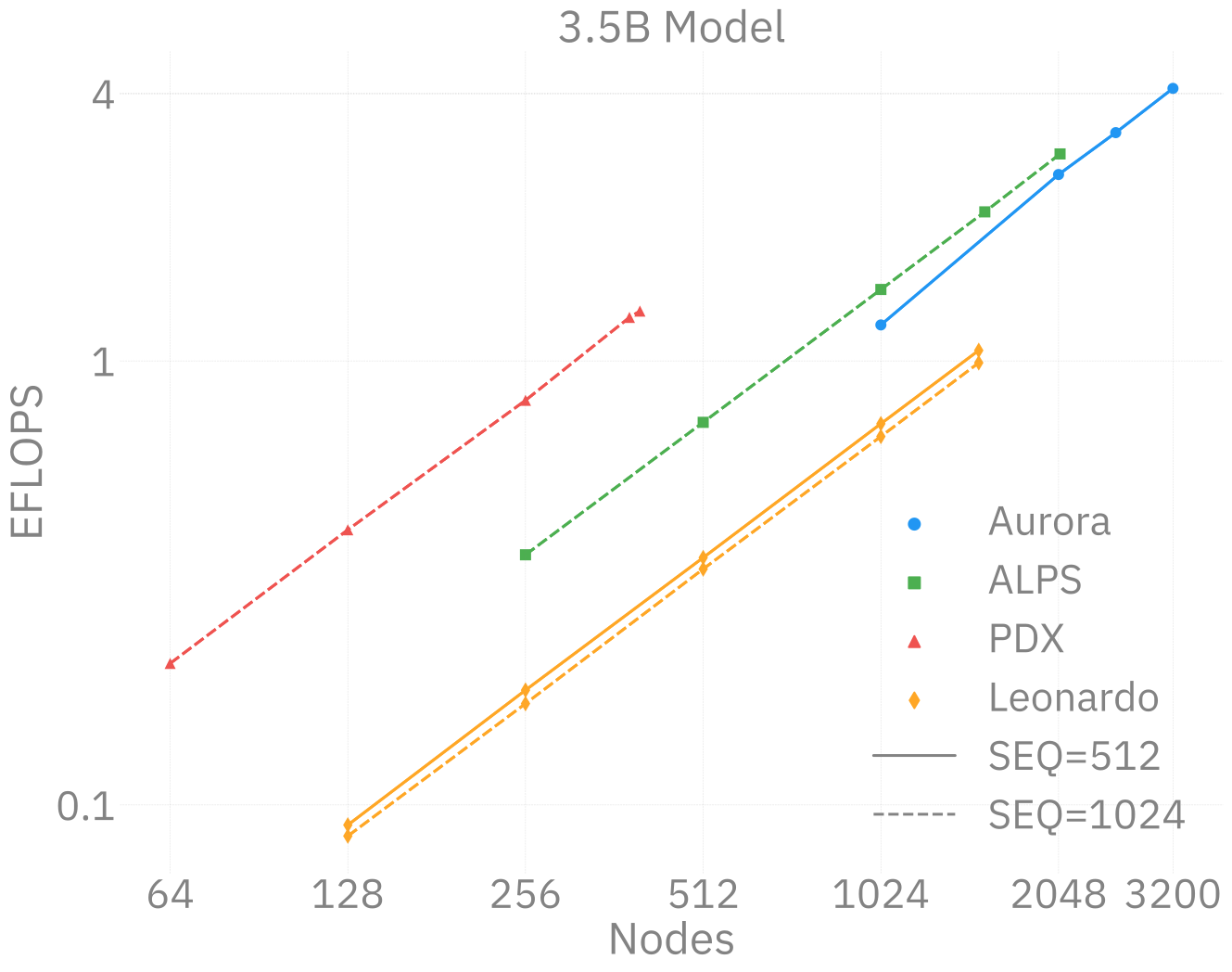
Figure 11: 3.5B model
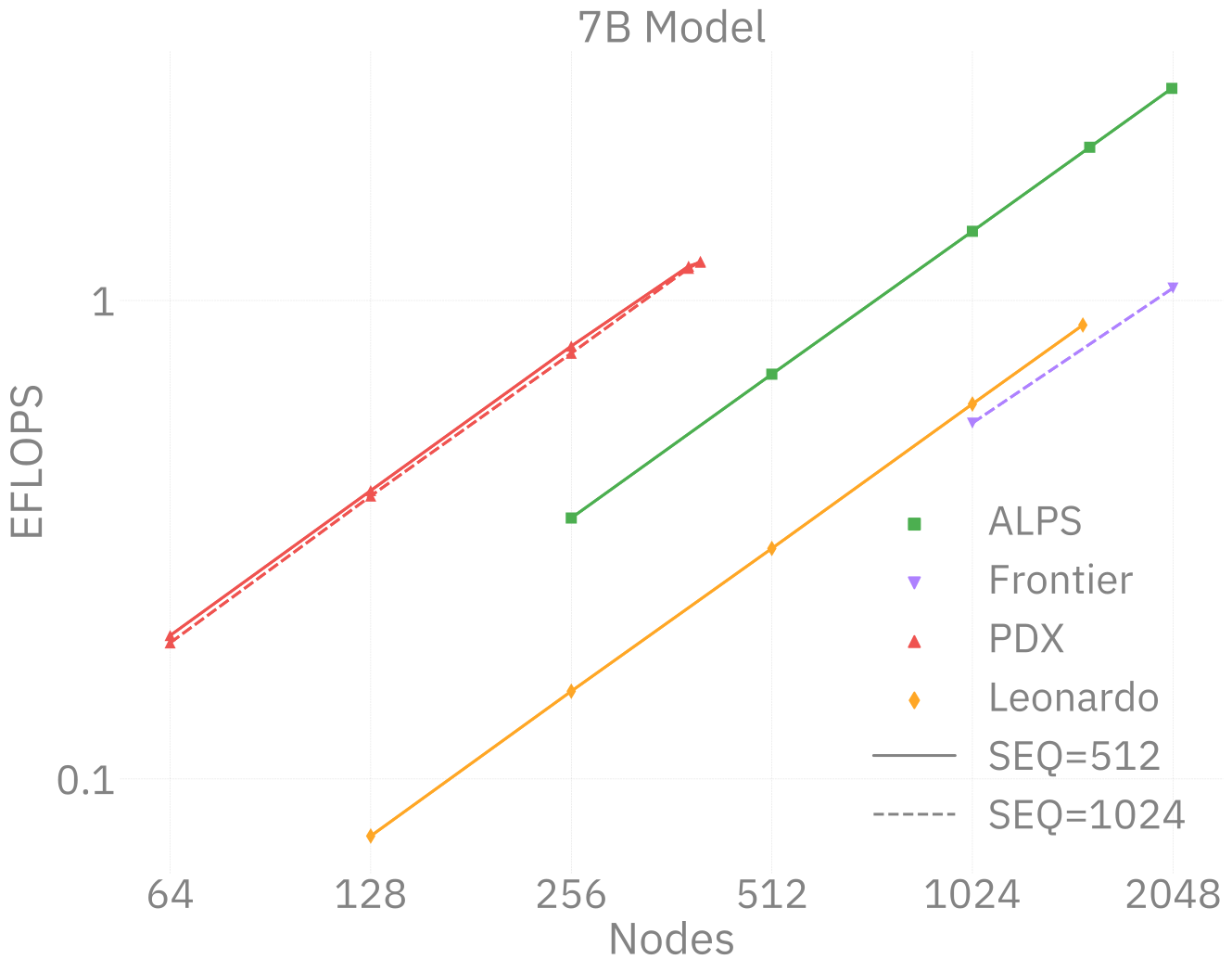
Figure 12: 7B model
🚂 Loooooooooong Sequence Lengths


- Working with
Microsoft/DeepSpeed team to
enable longer sequence lengths (context windows) for LLMs
- See my blog post for additional details
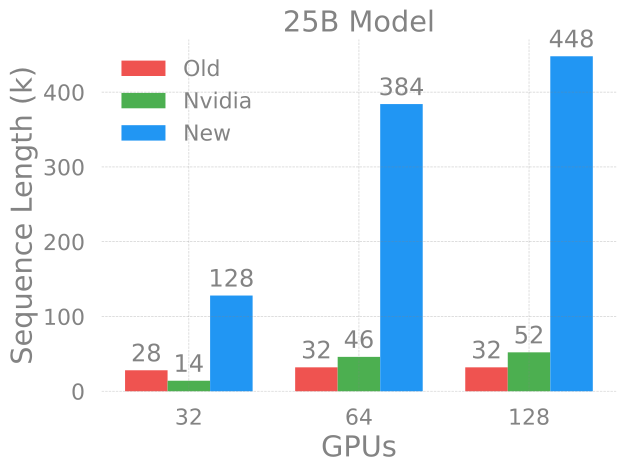
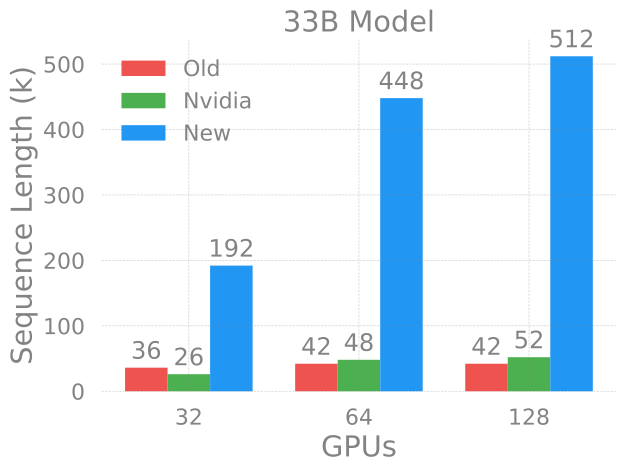
Figure 13: Maximum (achievable) SEQ_LEN for both 25B and 33B
models (See: Song et al. (2023))
♻️ Life Cycle of the LLM
📝 Pre-training
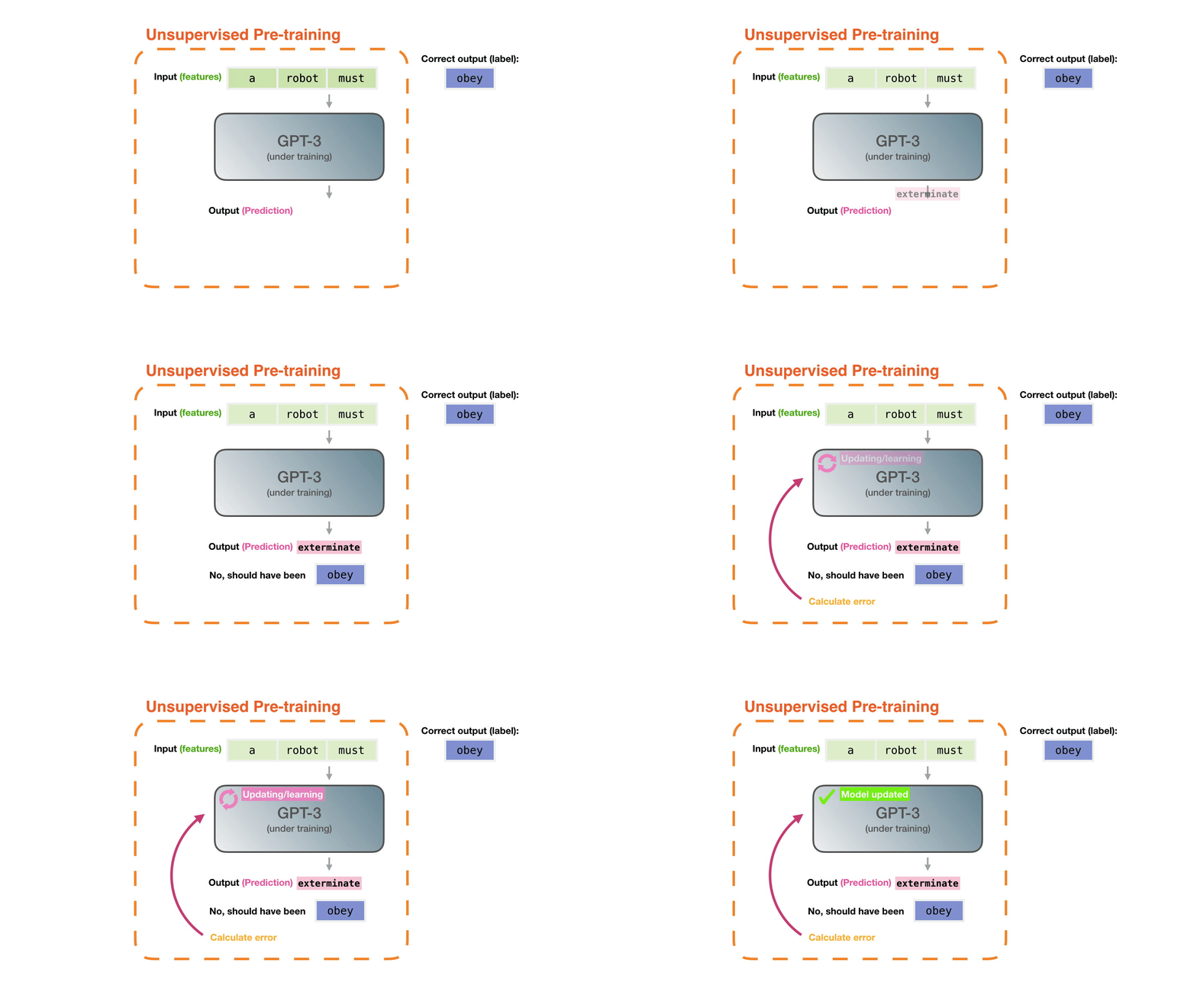
Figure 14: Pre-training: Virtually all of the compute used during pretraining phase
🎀 Fine-Tuning
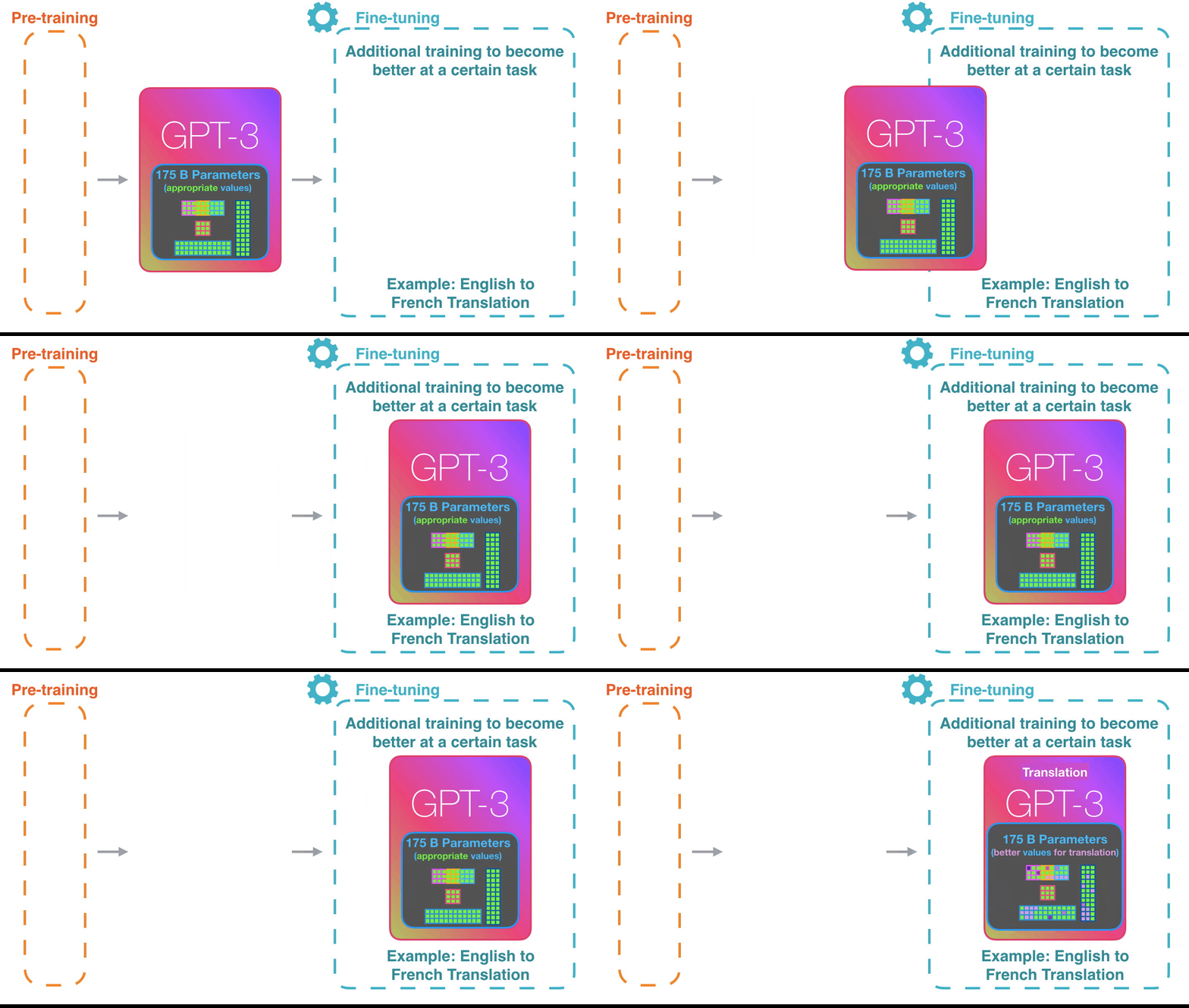
Figure 15: Fine-tuning: Fine-tuning actually updates the model’s weights to make the model better at a certain task.
🍎 Training LLMs

Figure 16: It’s hungry!

Figure 17: Visualization from Yang et al. (2023)
Footnotes
-
my talks can be found at: https://samforeman.me/talks/incite-hackathon-2025 ↩
-
(Dharuman et al. 2024) ↩
-
Co-led by: Venkat Vishwanath, Sam Foreman ↩
-
(Dharuman et al. 2024) ↩