Training Foundation Models on Supercomputers
Sam Foreman 2025-10-15
- 🌐 Distributed Training
- 🚀 Scaling: Overview
- 🐢 Training on a Single Device
- 🕸️ Parallelism Strategies
- 👬 Training on Multiple GPUs: Data Parallelism
- ▶️ Data Parallel: Forward Pass
- ◀️ Data Parallel: Backward Pass
- 🔄 Collective Communication
- Reduce
- 🐣 Getting Started: In Practice
- 📝 Plan of Attack
- 🚀 Going Beyond Data Parallelism
- Going beyond Data Parallelism: DeepSpeed +
ZeRO - 🕸️ Additional Parallelism Strategies
- Pipeline Parallelism (PP)
- Tensor Parallel (TP)
- Tensor Parallel (TP)
- Tensor (/ Model) Parallel Training: Example
- 🏗️ Aurora
- 🌌 AuroraGPT (2024–)
- 🧬 MProt-DPO
- 🌎 AERIS (2025)
- 📓 References
- ❤️ Acknowledgements
🌐 Distributed Training
🚀 Scaling: Overview
-
✅ Goal:
- Minimize: Cost (i.e. amount of time spent training)
- Maximize: Performance
[!NOTE]
📑 Note
See 🤗 Performance and Scalability for more details
In this talk, we will explore the intricacies of training foundation models on supercomputers. We will discuss the architecture of these models, the computational requirements, and the strategies employed to optimize training processes. Attendees will gain insights into the latest advancements in hardware and software that facilitate efficient model training at scale.
🐢 Training on a Single Device
flowchart LR
    subgraph G0["`GPU0`"]
        subgraph N0["`Network`"]
        end
        L0("`Loss`")
    end
    subgraph D["`Data`"]
        x("`x0`")
        x1("`x1`")
        x2("`x2`")
    end
    x --> N0
    N0 --> L0
    L0 --> N0
classDef block fill:#CCCCCC02,stroke:#838383,stroke-width:1px,color:#838383
classDef eblock fill:#CCCCCC02,stroke:#838383,stroke-width:0px,color:#838383
classDef red fill:#ff8181,stroke:#333,stroke-width:1px,color:#000
classDef green fill:#98E6A5,stroke:#333,stroke-width:1px,color:#000
classDef blue fill:#7DCAFF,stroke:#333,stroke-width:1px,color:#000
classDef grey fill:#cccccc,stroke:#333,stroke-width:1px,color:#000
class x,L0 red
class x1 green
class x2 blue
class x3 grey
class N0,G0,n0 block
class D eblock
Figure 1: SLOW !! model size limited by GPU memory
🕸️ Parallelism Strategies
- Data Parallelism
- Split data across workers
- Easiest to implement
- No changes to model
- Model Parallelism
- Split model across workers
- Hybrid Parallelism
- Combine data + model parallelism
- More complex to implement
- Requires changes to model
👬 Training on Multiple GPUs: Data Parallelism
flowchart LR
    subgraph D["`Data`"]
        direction TB
        x2("`x2`")
        x1("`x1`")
        x("`x0`")
    end
    direction LR
    subgraph G0["`GPU0`"]
        direction LR
        subgraph N0["`NN`"]
        end
        %%y0("`y₀`")
        L0["`Loss`"]
    end
    subgraph G1["`GPU1`"]
        direction LR
        subgraph N1["`NN`"]
        end
        L1["`Loss`"]
    end
    subgraph G2["`GPU2`"]
        direction LR
        subgraph N2["`NN`"]
        end
        L2["`Loss`"]
    end
    x --> N0
    x1 --> N1
    x2 --> N2
    N0 --> L0
    N1 --> L1
    N2 --> L2
classDef block fill:#CCCCCC02,stroke:#838383,stroke-width:1px,color:#838383
classDef eblock fill:#CCCCCC02,stroke:#838383,stroke-width:0px,color:#838383
classDef text fill:#CCCCCC02,stroke:#838383,stroke-width:0px,color:#838383
classDef grey fill:#cccccc,stroke:#333,stroke-width:1px,color:#000
classDef red fill:#ff8181,stroke:#333,stroke-width:1px,color:#000
classDef orange fill:#FFC47F,stroke:#333,stroke-width:1px,color:#000
classDef yellow fill:#FFFF7F,stroke:#333,stroke-width:1px,color:#000
classDef green fill:#98E6A5,stroke:#333,stroke-width:1px,color:#000
classDef blue fill:#7DCAFF,stroke:#333,stroke-width:1px,color:#000
classDef purple fill:#FFCBE6,stroke:#333,stroke-width:1px,color:#000
classDef eblock fill:#CCCCCC02,stroke:#838383,stroke-width:0px,color:#838383
class x,y0,L0 red
class x1,L1 green
class x2,L2 blue
class x3,ar grey
class N0,N1,N2,G0,G1,G2,GU block
class D eblock
class AR block
class bc text
Figure 2: Each GPU receives unique data at each step
▶️ Data Parallel: Forward Pass
flowchart LR
    subgraph D["`Data`"]
        direction TB
        x("`x0`")
        x1("`x1`")
        x2("`x2`")
    end
    direction LR
    subgraph G0["`GPU0`"]
        direction LR
        subgraph N0["`NN`"]
        end
        L0["`Loss`"]
    end
    subgraph G1["`GPU1`"]
        direction LR
        subgraph N1["`NN`"]
        end
        L1["`Loss`"]
    end
    subgraph G2["`GPU2`"]
        direction LR
        subgraph N2["`NN`"]
        end
        L2["`Loss`"]
    end
    ar("`Avg. Grads (∑ₙgₙ)/N`")
    x --> G0
    x1 --> G1
    x2 --> G2
    N0 --> L0
    N1 --> L1
    N2 --> L2
    L0 -.-> ar
    L1 -.-> ar
    L2 -.-> ar
classDef eblock fill:#CCCCCC02,stroke:#838383,stroke-width:0px,color:#838383
classDef block fill:#CCCCCC02,stroke:#838383,stroke-width:1px,color:#838383
classDef grey fill:#cccccc,stroke:#333,stroke-width:1px,color:#000
classDef red fill:#ff8181,stroke:#333,stroke-width:1px,color:#000
classDef orange fill:#FFC47F,stroke:#333,stroke-width:1px,color:#000
classDef yellow fill:#FFFF7F,stroke:#333,stroke-width:1px,color:#000
classDef green fill:#98E6A5,stroke:#333,stroke-width:1px,color:#000
classDef blue fill:#7DCAFF,stroke:#333,stroke-width:1px,color:#000
classDef purple fill:#FFCBE6,stroke:#333,stroke-width:1px,color:#000
classDef text fill:#CCCCCC02,stroke:#838383,stroke-width:0px,color:#838383
class x,y0,L0 red
class x1,L1 green
class x2,L2 blue
class x3,ar grey
class N0,N1,N2,G0,G1,G2,GU block
class D eblock
class AR block
class bc text
Figure 3: Average gradients across all GPUs
◀️ Data Parallel: Backward Pass
flowchart RL
    subgraph D["`Data`"]
        direction TB
        x("`x0`")
        x1("`x1`")
        x2("`x1`")
    end
    subgraph G0["`GPU0`"]
        direction RL
        subgraph N0["`NN`"]
        end
        L0["`Loss`"]
    end
    subgraph G1["`GPU1`"]
        direction RL
        subgraph N1["`NN`"]
        end
        L1["`Loss`"]
    end
    subgraph G2["`GPU2`"]
        direction RL
        subgraph N2["`NN`"]
        end
        L2["`Loss`"]
    end
    subgraph BC["`Send Updates`"]
        direction TB
    end
    BC -.-> G0
    BC -.-> G1
    BC -.-> G2
    L0 ~~~ N0
    L1 ~~~ N1
    L2 ~~~ N2
    G0 ~~~ x
    G1 ~~~ x1
    G2 ~~~ x2
classDef grey fill:#cccccc,stroke:#333,stroke-width:1px,color:#000
classDef eblock fill:#CCCCCC02,stroke:#838383,stroke-width:0px,color:#838383
classDef block fill:#CCCCCC02,stroke:#838383,stroke-width:1px,color:#838383
classDef red fill:#ff8181,stroke:#333,stroke-width:1px,color:#000
classDef orange fill:#FFC47F,stroke:#333,stroke-width:1px,color:#000
classDef yellow fill:#FFFF7F,stroke:#333,stroke-width:1px,color:#000
classDef green fill:#98E6A5,stroke:#333,stroke-width:1px,color:#000
classDef blue fill:#7DCAFF,stroke:#333,stroke-width:1px,color:#000
classDef purple fill:#FFCBE6,stroke:#333,stroke-width:1px,color:#000
classDef text fill:#CCCCCC02,stroke:#838383,stroke-width:0px,color:#838383
class x,y0,L0 red
class x1,L1 green
class x2,L2 blue
class x3,ar grey
class N0,N1,N2,G0,G1,G2,GU block
class BC block
class bc text
class D eblock
Figure 4: Send global updates back to each GPU. See: PyTorch / Distributed Data Parallel
🔄 Collective Communication
- Broadcast: Send data from one node to all other nodes
- Reduce: Aggregate data from all nodes to one node
- AllReduce: Aggregate data from all nodes to all nodes
- Gather: Collect data from all nodes to one node
- AllGather: Collect data from all nodes to all nodes
- Scatter: Distribute data from one node to all other nodes
Reduce
- Perform a reduction on data across ranks, send to individual
flowchart TD
  subgraph R0["`0`"]
    x0("`x0`")
  end
  subgraph R1["`1`"]
    x1("`x1`")
  end
  subgraph R2["`2`"]
    x2("`x2`")
  end
  subgraph R3["`3`"]
    x3("`x3`")
  end
  subgraph AR["`Reduce`"]
    xp["`z=reduce(x, 2, SUM)`"]
  end
  subgraph AR3["`3`"]
  end
  subgraph AR2["`2`"]
    xp2("`z`")
  end
  subgraph AR1["`1`"]
  end
  subgraph AR0["`0`"]
  end
  x0 --> AR
  x1 --> AR
  x2 --> AR
  x3 --> AR
  AR --> AR3
  AR --> xp2
  AR --> AR1
  AR --> AR0
classDef block fill:#CCCCCC02,stroke:#838383,stroke-width:1px,color:#838383
classDef red fill:#ff8181,stroke:#333,stroke-width:1px,color:#000
classDef orange fill:#FFC47F,stroke:#333,stroke-width:1px,color:#000
classDef green fill:#98E6A5,stroke:#333,stroke-width:1px,color:#000
classDef yellow fill:#FFFF7F,stroke:#333,stroke-width:1px,color:#000
classDef blue fill:#7DCAFF,stroke:#333,stroke-width:1px,color:#000
classDef purple fill:#FFCBE6,stroke:#333,stroke-width:1px,color:#000
classDef pink fill:#E599F7,stroke:#333,stroke-width:1px,color:#000
class R0,R1,R2,R3,AR,AR0,AR1,AR2,AR3 block
class xp,xp2 purple
class x0 red
class x1 green
class x2 blue
class x3 yellow
Figure 5: Reduce operation: one rank receives the reduction of input values across ranks
🐣 Getting Started: In Practice
- 📦 Distributed Training Frameworks:
- 🍋 saforem2 /
ezpz - 🤖 Megatron-LM
- 🤗 Accelerate
- 🔥 PyTorch
- 🍋 saforem2 /
- 🚀 DeepSpeed
- 🧠 Memory Management:
- FSDP vs. ZeRO
- Activation Checkpointing
- Mixed Precision Training
- Gradient Accumulation
- Offloading to CPU/NVMe
[!IMPORTANT]
🔄 Keeping things in Sync
Computation stalls during communication !!
Keeping the communication to computation ratio small is important for effective scaling.
📝 Plan of Attack
flowchart TB
    A{"Model Perfect?"}
    A -- no --> M{"Available Memory?"}
    A -- yes --> AD["Done"]
    M -- yes --> MY["Make Model Larger"]
    M -- no --> ZMP["<b>Free Up Memory</b>"]
    MY --> A
    ZMP --> MY
    A:::block
    M:::block
    AD:::block
    MY:::block
    ZMP:::sblock
    classDef text fill:#CCCCCC02,stroke:#838383,stroke-width:0px,color:#838383
    classDef sblock fill:#CCCCCC02,stroke:#838383,stroke-width:1px,color:#838383,white-space:collapse
    classDef block fill:#CCCCCC02,stroke:#838383,stroke-width:1px,color:#838383
Figure 6: General strategy for scaling model training
🚀 Going Beyond Data Parallelism
- ✅ Useful when model fits on single GPU:
- ultimately limited by GPU memory
- model performance limited by size
- ⚠️ When model does not fit on a single GPU:
- Offloading (can only get you so far…):
- Otherwise, resort to model parallelism strategies
Going beyond Data Parallelism: DeepSpeed + ZeRO
- Depending on the
ZeROstage (1, 2, 3), we can offload:- Stage 1: optimizer states
- Stage 2: gradients + opt. states
- Stage 3: model params + grads + opt. states

🕸️ Additional Parallelism Strategies
- Tensor (/ Model) Parallelism (
TP): - Pipeline Parallelism (
PP): - Sequence Parallelism (
SP): - argonne-lcf/
Megatron-DeepSpeed- Supports 4D Parallelism (
DP+TP+PP+SP)
- Supports 4D Parallelism (
Pipeline Parallelism (PP)
- Model is split up vertically (layer-level) across multiple GPUs
- Each GPU:
- has a portion of the full model
- processes in parallel different stages of the pipeline (on a small chunk of the batch)
- See:
flowchart TB
    subgraph G0["`GPU 0`"]
        direction LR
        a0("`Layer 0`")
        b0("`Layer 1`")
    end
    subgraph G1["`GPU 1`"]
        direction LR
        a1("`Layer 2`")
        b1("`Layer 3`")
    end
    a0 -.-> b0
    b0 --> a1
    a1 -.-> b1
classDef block fill:#CCCCCC02,stroke:#838383,stroke-width:1px,color:#838383
classDef red fill:#ff8181,stroke:#333,stroke-width:1px,color:#000
classDef orange fill:#FFC47F,stroke:#333,stroke-width:1px,color:#000
classDef yellow fill:#FFFF7F,stroke:#333,stroke-width:1px,color:#000
classDef green fill:#98E6A5,stroke:#333,stroke-width:1px,color:#000
classDef blue fill:#7DCAFF,stroke:#333,stroke-width:1px,color:#000
classDef purple fill:#FFCBE6,stroke:#333,stroke-width:1px,color:#000
class G0,G1 block
class a0 red
class b0 green
class a1 blue
class b1 yellow
Figure 8: Pipeline Parallelism
Tensor Parallel (TP)
Tensor Parallel (TP)
- Split up network over multiple workers
- Each receives disjoint subset
- All communication associated with subsets are distributed
- Communication whenever dataflow between two subsets
- Typically more complicated to implement than data parallel training
- Suitable when the model is too large to fit onto a single device (CPU / GPU)
Tensor (/ Model) Parallel Training: Example
Want to compute:
where each GPU has only its portion of the full weights as shown below
- Compute:
GPU1 - Compute:
GPU2 - Compute: ✅
flowchart LR
    subgraph X0["`GPU0`"]
        direction LR
        a("`W0`")
    end
    subgraph X1["`GPU1`"]
        direction LR
        b("`W1`")
    end
    subgraph X2["`GPU2`"]
        direction LR
        c("`W2`")
    end
  t0("`x0`")-->X0
  X0 -->|"`x0 W0`"|X1
  X1 -->|"`x0 W0 + x1 W1`"|X2
  t1("`x1`") --> X1
  t2("`x1`") --> X2
Figure 11


🌀 Sequence-Window-Pipeline Parallelism SWiPe
SWiPeis a novel parallelism strategy for Swin-based Transformers- Hybrid 3D Parallelism strategy, combining:
- Sequence parallelism (
SP) - Window parallelism (
WP) - Pipeline parallelism (
PP)
- Sequence parallelism (
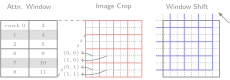
Figure 23
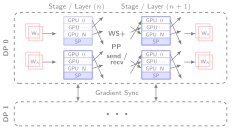
Figure 24: SWiPe Communication Patterns
🚀 AERIS: Scaling Results
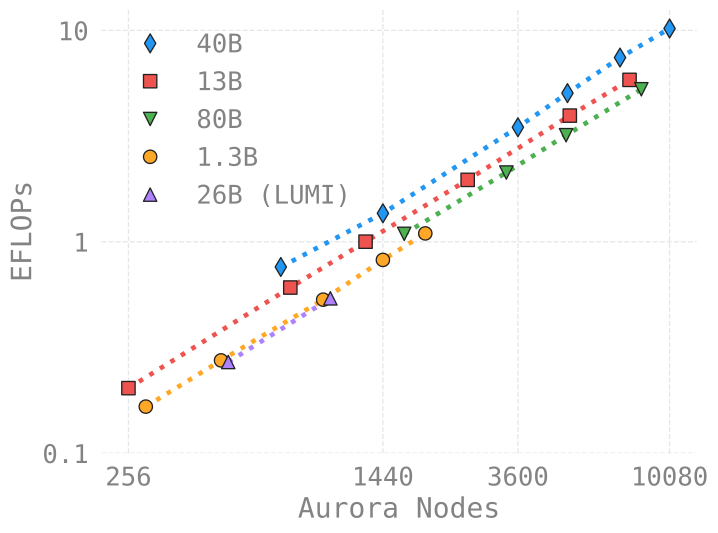
Figure 25: AERIS: Scaling Results
- 10 EFLOPs (sustained) @ 120,960 GPUs
- See (Hatanpää et al. (2025)) for additional details
- arXiv:2509.13523
🌪️ Hurricane Laura
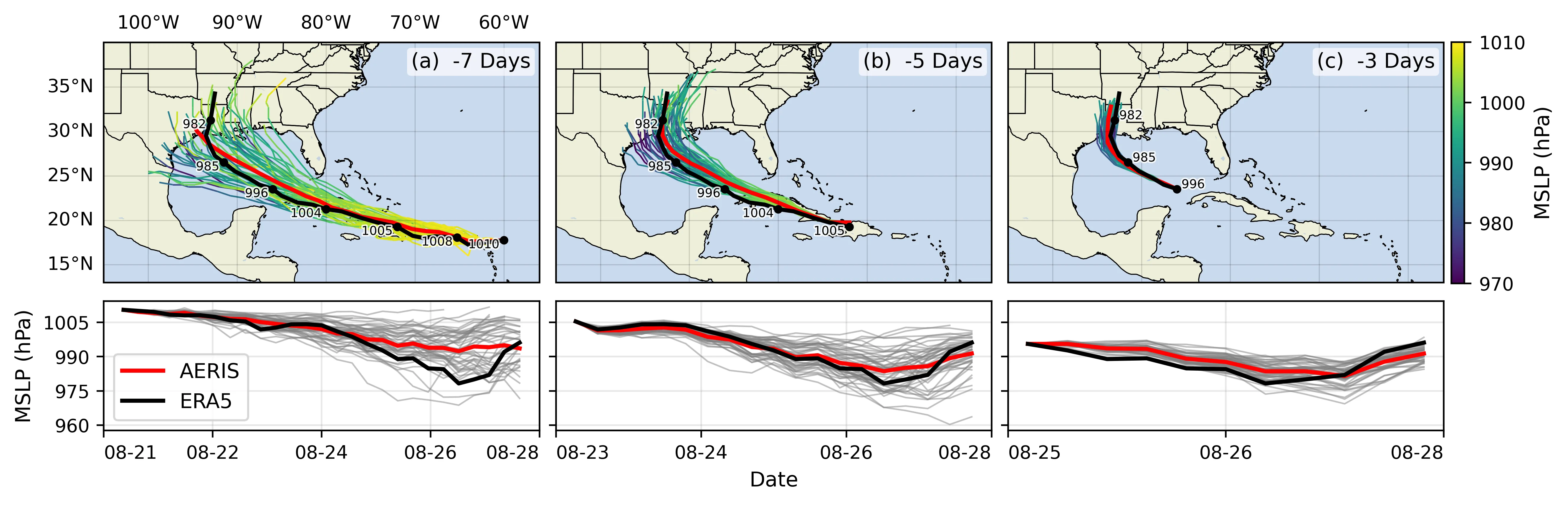
Figure 26: Hurricane Laura tracks (top) and intensity (bottom). Initialized 7(a), 5(b) and 3(c) days prior to 2020-08-28T00z.
📓 References
Hatanpää, Väinö, Eugene Ku, Jason Stock, et al. 2025. AERIS: Argonne Earth Systems Model for Reliable and Skillful Predictions. https://arxiv.org/abs/2509.13523.
Price, Ilan, Alvaro Sanchez-Gonzalez, Ferran Alet, et al. 2024. GenCast: Diffusion-Based Ensemble Forecasting for Medium-Range Weather. https://arxiv.org/abs/2312.15796.
Song, Shuaiwen Leon, Bonnie Kruft, Minjia Zhang, et al. 2023. DeepSpeed4Science Initiative: Enabling Large-Scale Scientific Discovery Through Sophisticated AI System Technologies. https://arxiv.org/abs/2310.04610.
❤️ Acknowledgements
This research used resources of the Argonne Leadership Computing Facility, which is a DOE Office of Science User Facility supported under Contract DE-AC02-06CH11357.